<?xml version="1.0" encoding="UTF-8"?>
<feed xml:lang="en" xmlns="http://www.w3.org/2005/Atom" xmlns:opensearch="http://a9.com/-/spec/opensearch/1.1/" xmlns:s="http://jadedpixel.com/-/spec/shopify">
  <id>https://www.finelineflag.com/blogs/news.atom</id>
  <link rel="alternate" type="text/html" href="https://www.finelineflag.com/blogs/news"/>
  <link rel="self" type="application/atom+xml" href="https://www.finelineflag.com/blogs/news.atom"/>
  <title>Fine Line Flag - Patriot Journal – A Patriotic Blog of Flag Etiquette Articles, USA Pride Stories, American Flag History, and Seasonal Flag Education for Proud Americans</title>
  <updated>2020-04-04T20:16:00-05:00</updated>
  <author>
    <name>Fine Line Flag</name>
  </author>
  <entry>
    <id>https://www.finelineflag.com/blogs/news/how-to-fold-the-american-flag</id>
    <published>2020-04-04T20:16:00-05:00</published>
    <updated>2026-10-08T14:53:54-05:00</updated>
    <link rel="alternate" type="text/html" href="https://www.finelineflag.com/blogs/news/how-to-fold-the-american-flag"/>
    <title>Is There a Proper Way to Fold The American Flag?</title>
    <author>
      <name>Trigg Thorstenson</name>
    </author>
    <summary type="html">
      <![CDATA[<p class="p1">Folding the American Flag correctly is more than tradition—it’s a sign of respect. In this guide from Fine Line Flag, we walk you through the proper way to fold the U.S. flag, step by step, and explain the meaning behind each of the 13 folds.</p><p><a class="read-more" href="https://www.finelineflag.com/blogs/news/how-to-fold-the-american-flag">More</a></p>]]>
    </summary>
    <content type="html">
      <![CDATA[<h2>Folding the American Flag Serves More Than One Purpose</h2>
<p>In a <strong>practical</strong> sense, a proper flag fold goes a long way in terms of <strong>flag care, maintenance, and storage</strong>.</p>
<p>You may not have occasion to fold a flag very often. But it is Army and Navy custom to lower the flag daily, at the last note of retreat. The flag is then folded in a triangle shape.</p>
<p>It is said the shape is similar to that of hats worn by the colonial soldiers. Is the shape a coincidence, or intentional? We'll see.</p>
<p>As a <strong>symbolic</strong> gesture, flag folding plays an important role in showing respect for the flag and what it represents. It is a moving and meaningful part of many ceremonies, including funeral services and burial rites.</p>
<p>Knowing the basics and a little bit of history will serve you in many ways.</p>
<h2>What Is the Proper Way to Fold the American Flag?</h2>
<p>For starters, there is <strong>no "official" way to fold the American flag</strong>.</p>
<p>The <a href="https://www.law.cornell.edu/uscode/text/4/chapter-1" target="_blank" title="US Flag Code" rel="noopener noreferrer">U.S. Flag Code</a> is the first place to look for flag display and etiquette. It is full of rules governing when, where, and how to display the US flag, but there are <strong>no guidelines on folding</strong>.</p>
<p>One reason is because flags vary in size. There is a <a href="/blogs/news/parts-of-the-american-flag" title="Standard dimensions of the US flag">standard ratio for government flags</a>, but in practical use not all flags maintain the same ratios. Common flag sizes are <a href="/products/12x18-inch-american-boat-flag-marine-nylon" title="12x18 Inch American Flag">12x18 in</a>, <a href="/products/2x3-ft-outdoor-nylon-american-flag-made-in-usa" title="2x3 Foot American Flag">2x3 ft</a>, <a href="/products/2-5x4-ft-outdoor-nylon-american-flag-made-in-usa" title="2.5x4 Foot American Flag">2.5x4 ft</a>, <a href="/products/3x5-ft-outdoor-nylon-american-flag-made-in-usa" title="3x5 Foot American Flag">3x5 ft</a>, <a href="/products/4x6-ft-outdoor-nylon-american-flag-made-in-usa" title="4x6 Foot American Flag">4x6 ft</a>, <a href="/products/5x8-ft-outdoor-nylon-american-flag-made-in-usa" title="5x8 Foot American Flag">5x8 ft</a>, and bigger.</p>
<p>Interment flags used for burial services are 5x9.5 ft.</p>
<p><strong>Not every flag will fold into the same shape with the same number of folds.</strong></p>
<p>Since the flag code leaves us searching for answers, we turn to the branches of the military, the <a href="https://www.va.gov/opa/pressrel/pressrelease.cfm?id=1406" target="_blank" title="Department of Veterans Affairs" rel="noopener noreferrer">VA</a> (Department of Veterans Affairs), <a href="https://www.legion.org/flag/folding" target="_blank" title="American Legion Flag Folding" rel="noopener noreferrer">American Legion</a>, <a href="https://www.vfw.org/community/flag-etiquette" target="_blank" title="Veterans of Foreign War" rel="noopener noreferrer">VFW</a>, and the <a href="http://www.bsatroop66.org/Training/Scouters%20Guide-US%20Flag%20Ceremonies.pdf" target="_blank" title="Boy Scouts Guidelines on Flag Etiquette" rel="noopener noreferrer">Boy Scouts of America</a>.</p>
<p>Even the Army, Air Force, Navy, Marines, and Coast Guard all have their own unique variations for handling the flag. (More on that later.)</p>
<p>Our conclusion is that there is no <strong>"proper" or "correct" way to fold the American flag.</strong> But there is a model and best practice to follow.</p>
<p>Showing respect for the flag and what it represents is what really matters. The actual details leave room for interpretation.</p>
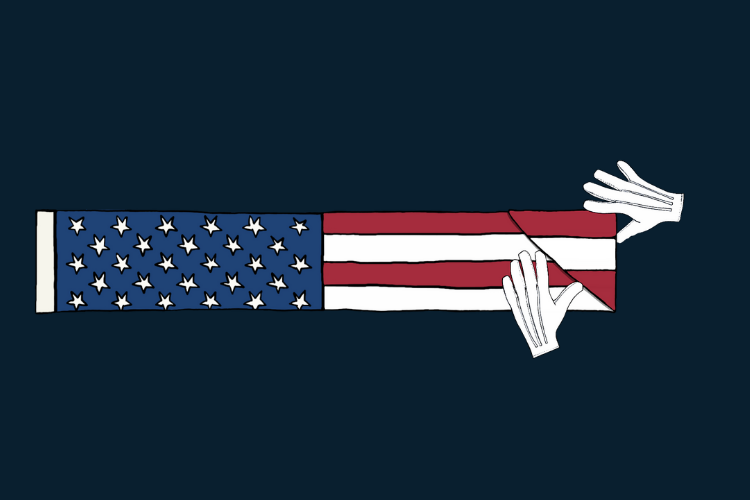
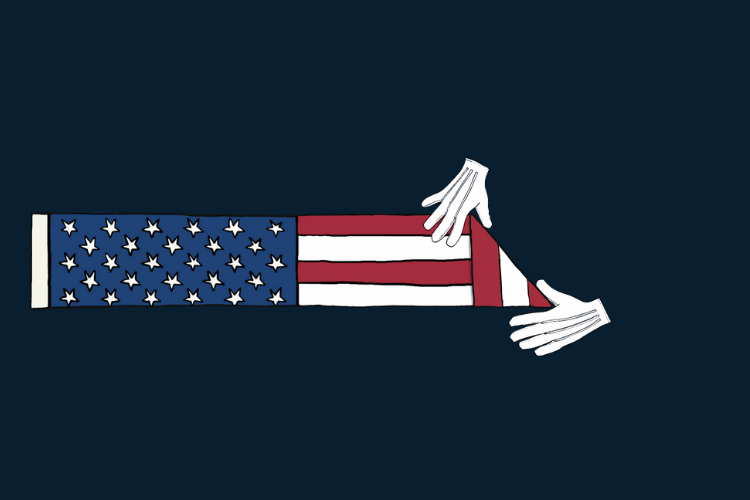
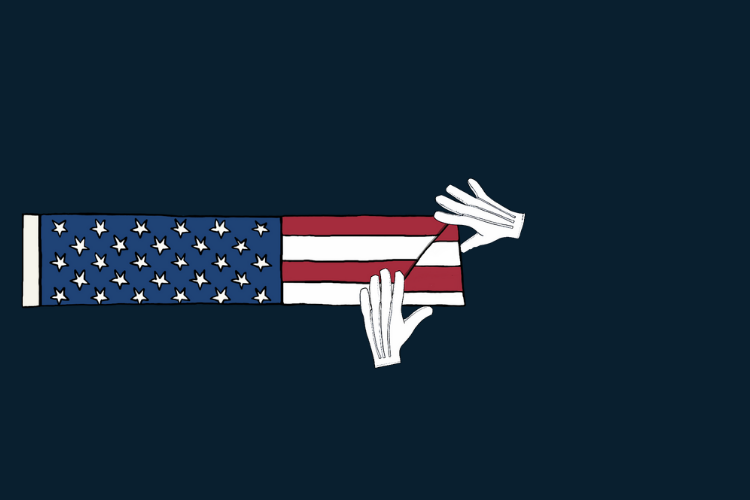
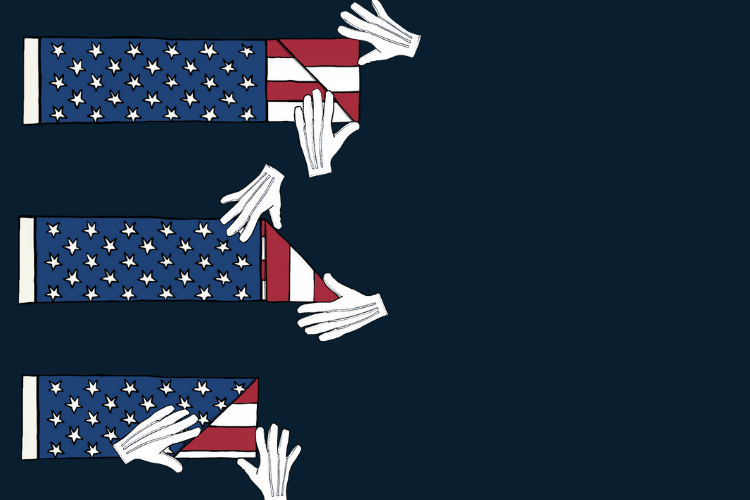
<p style="text-align: center;"><img alt="How to Fold the American Flag" src="//cdn.shopify.com/s/files/1/0993/6346/files/How-To-Fold-A-Flag_2048x2048.gif?v=1585755806"></p>
<h2 style="text-align: center;">Step by Step: How to Fold the American Flag</h2>
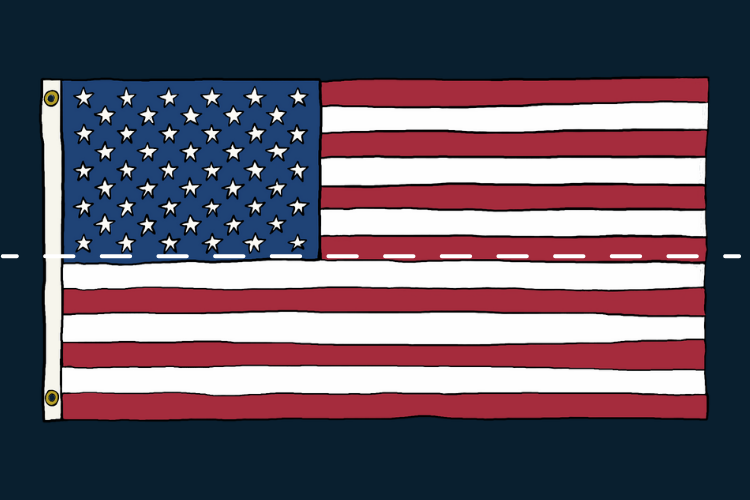
<p style="text-align: center;"><img alt="US Flag with dotted fold line" src="//cdn.shopify.com/s/files/1/0993/6346/files/American_Flag_with_dotted_line_to_show_fold_in_half_2048x2048.png?v=1586025079" style="display: block; margin-left: auto; margin-right: auto;"></p>
<h4 style="text-align: center;">Hold the flag stretched out and parallel to the ground</h4>
<p style="text-align: center;">(It helps to maintain tension between the two ends.)</p>
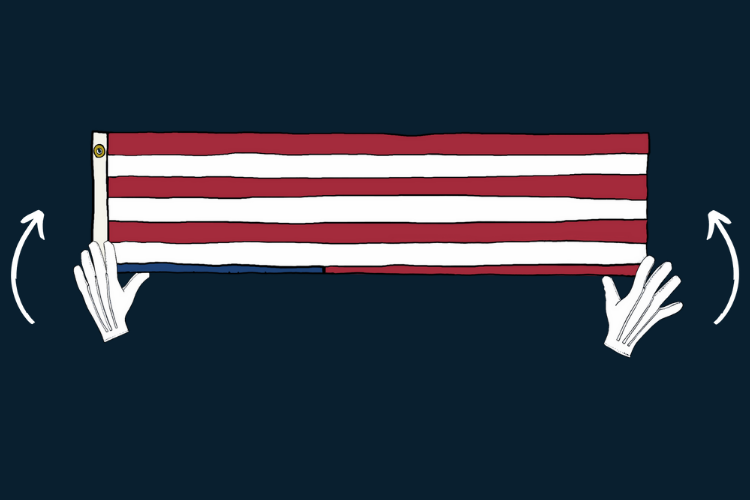
<p style="text-align: center;"><img alt="American flag folded in half lengthwise" src="//cdn.shopify.com/s/files/1/0993/6346/files/American_flag_folded_in_half_2048x2048.png?v=1586025554" style="display: block; margin-left: auto; margin-right: auto;"></p>
<h4 style="text-align: center;">1. Fold in half lengthwise</h4>
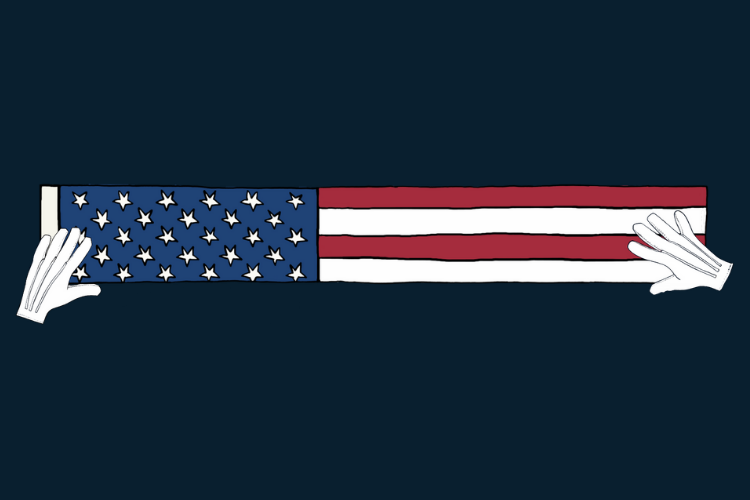
<p style="text-align: center;"><img alt="American flag folded in half a second time" src="//cdn.shopify.com/s/files/1/0993/6346/files/US_Flag_folded_a_second_time_lengthwise_2048x2048.png?v=1586025809" style="display: block; margin-left: auto; margin-right: auto;"></p>
<h4 style="text-align: center;">2. Fold in half again</h4>
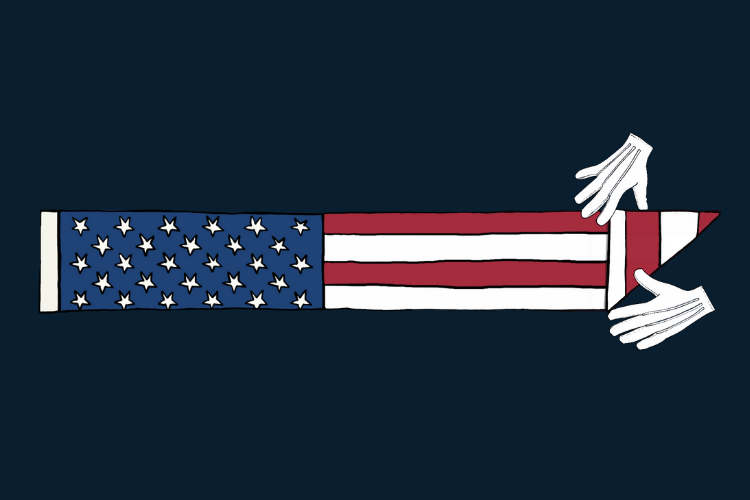
<p style="text-align: center;"><img alt="First triangle fold of the US flag" src="//cdn.shopify.com/s/files/1/0993/6346/files/American_flag_first_triangle_fold_2048x2048.png?v=1586025971" style="display: block; margin-left: auto; margin-right: auto;"></p>
<h4 style="text-align: center;">3. From the <a href="/blogs/news/parts-of-the-american-flag" title="Parts of the American flag">fly end</a>, fold a triangle from the folded edge to the open edge</h4>
<p style="text-align: center;"><img alt="Second triangle fold" src="//cdn.shopify.com/s/files/1/0993/6346/files/Second_Triangle_fold_of_US_Flag_2048x2048.png?v=1586026426" style="display: block; margin-left: auto; margin-right: auto;"></p>
<h4 style="text-align: center;">4. Repeat triangle folds toward the <a href="/blogs/news/parts-of-the-american-flag" title="Parts of the US flag">canton</a>
</h4>
<p style="text-align: center;"><img alt="Third triangle fold of the American flag" src="//cdn.shopify.com/s/files/1/0993/6346/files/Fold_3_of_American_flag_2048x2048.png?v=1586026620" style="display: block; margin-left: auto; margin-right: auto;"></p>
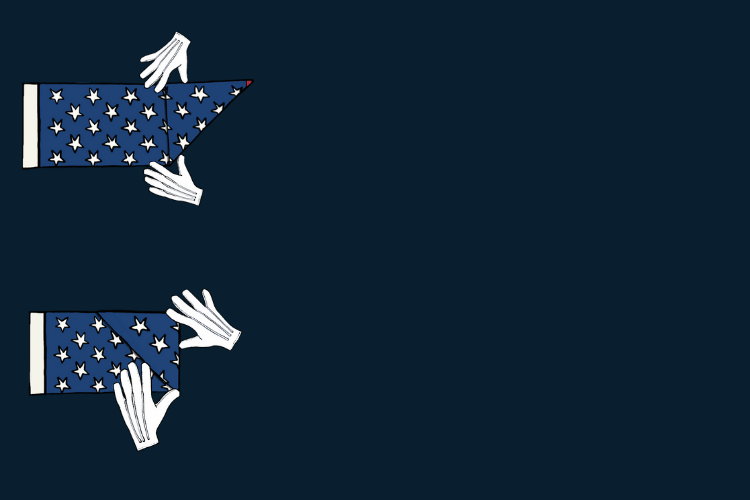
<h4 style="text-align: center;">5. Continue triangle folds</h4>
<p style="text-align: center;"><img alt="4th triangle fold of American flag" src="//cdn.shopify.com/s/files/1/0993/6346/files/two_hands_folding_American_flag_2048x2048.png?v=1586026852" style="display: block; margin-left: auto; margin-right: auto;"></p>
<h4 style="text-align: center;">6. Repeat</h4>
<p style="text-align: center;"><img alt="Folding American flag" src="//cdn.shopify.com/s/files/1/0993/6346/files/US_flag_being_folded_2048x2048.png?v=1586026992" style="display: block; margin-left: auto; margin-right: auto;"></p>
<h4 style="text-align: center;">7. There are 13 folds in total — keep going</h4>
<p style="text-align: center;"><img alt="Folding the flag" src="//cdn.shopify.com/s/files/1/0993/6346/files/Folding_the_flag_2048x2048.png?v=1586029274" style="display: block; margin-left: auto; margin-right: auto;"></p>
<h4 style="text-align: center;">8. Getting close to the end</h4>
<p style="text-align: center;"><img alt="Folding the flag to the canton" src="//cdn.shopify.com/s/files/1/0993/6346/files/folding_at_the_canton_2048x2048.png?v=1586029472" style="display: block; margin-left: auto; margin-right: auto;"></p>
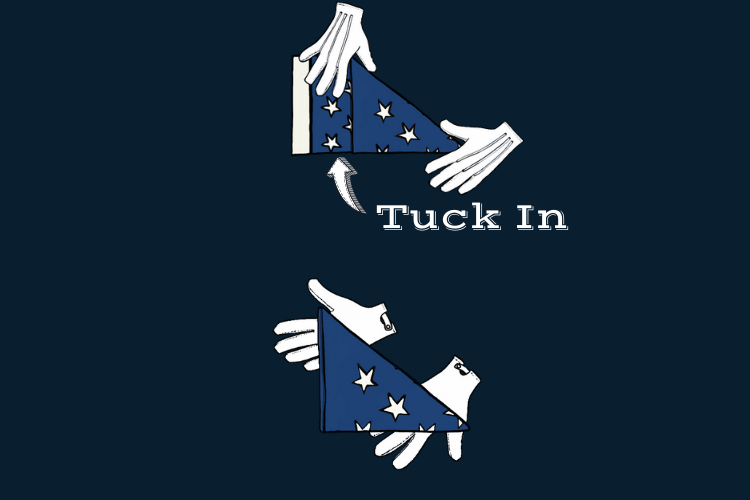
<h4 style="text-align: center;">9. Tuck the remaining edge into the triangle</h4>
<p style="text-align: center;"><img alt="Tuck in for final flag fold" src="//cdn.shopify.com/s/files/1/0993/6346/files/Tuck_in_for_the_final_fold_2048x2048.png?v=1586030065" style="display: block; margin-left: auto; margin-right: auto;"></p>
<p style="text-align: center;"><strong>This is the most common and basic way to fold the American flag.</strong></p>
<hr>
<p style="text-align: center;">As we mentioned before, each branch of the military adds their own subtle style to the pomp and circumstance of flag folding.</p>
<p style="text-align: center;">Here is a great example of a <strong>Marine Flag Folding</strong>. You might be surprised by the first fold and the end result.</p>
<p style="text-align: center;"><iframe width="560" height="315" src="https://www.youtube-nocookie.com/embed/ZVYYdOQ8RvM" frameborder="0" allow="accelerometer; autoplay; encrypted-media; gyroscope; picture-in-picture" allowfullscreen></iframe></p>
<h3 style="text-align: center;"><strong>Marine Corps Body Bearers — Respect</strong></h3>
<p style="text-align: center;"><iframe width="560" height="315" src="https://www.youtube-nocookie.com/embed/2yit37jz1l4" frameborder="0" allow="accelerometer; autoplay; encrypted-media; gyroscope; picture-in-picture" allowfullscreen></iframe></p>
<h2 style="text-align: center;">Do the Folds of the American Flag Have Meaning?</h2>
<p><strong>Yes. The ceremony of folding the American flag carries great meaning and symbolic reference.</strong> If you ever had a doubt, watch the Marine Corps Body Bearers above.</p>
<p>But it's a little bit of the chicken or the egg when it comes to what came first.</p>
<p>Were these symbols and meanings planned? Probably not. (There is no evidence that they were.) We believe the 13 folds exist because they work. As time goes by, traditions emerge and people ascribe meaning.</p>
<p style="text-align: center;">We'll present the most common interpretations and you can apply what works for you.</p>
<p><strong>Respect for the flag and what it represents is what is most important. The details leave room for freedom.</strong></p>
<p style="text-align: center;">During flag folding ceremonies, a "script" is often read. These scripts embody the symbolism of each fold and its meaning. Here are some popular examples.</p>
<h3 style="text-align: center;">13 Folds for the American Flag</h3>
<p><strong>Using the method above, there are 13 folds.</strong> (As we mentioned before, not every flag is the same size, so it can vary, but 13 is most traditional.)</p>
<p><strong>From the US Department of Veterans Affairs:</strong></p>
<p>"Honoring the burial wishes of veterans is one of the highest commitments for the men and women of VA," said William F. Tuerk, VA's Under Secretary for Memorial Affairs. "A family may request the recitation of words to accompany the meaningful presentation of the American flag as we honor the dedication and sacrifice of their loved ones."</p>
<p>Traditional gravesite military funeral honors include the silent folding and presentation of an American flag, a rifle salute, and the playing of "Taps."</p>
<p>Volunteer honor guards are authorized to read the so-called "13-fold" flag recitation or any comparable script.</p>
<h3 style="text-align: center;">"13-Fold Script"</h3>
<p>The flag folding ceremony represents the same religious principles on which our country was originally founded. The portion of the flag denoting honor is the canton of blue containing the stars representing the states our veterans served in uniform. The canton field of blue dresses from left to right and is inverted when draped as a pall on a casket of a veteran who has served our country in uniform.</p>
<p>In the Armed Forces of the United States, at the ceremony of retreat the flag is lowered, folded in a triangle fold and kept under watch throughout the night as a tribute to our nation's honored dead. The next morning it is brought out and, at the ceremony of reveille, run aloft as a symbol of our belief in the resurrection of the body.</p>
<p>(Wait for the Honor Guard or Flag Detail to unravel and fold the flag into a quarter fold — resume reading when Honor Guard is standing ready.)</p>
<ol>
<li>The first fold of our flag is a symbol of life.</li>
<li>The second fold is a symbol of our belief in the eternal life.</li>
<li>The third fold is made in honor and remembrance of the veteran departing our ranks who gave a portion of life for the defense of our country to attain a peace throughout the world.</li>
<li>The fourth fold represents our weaker nature, for as American citizens trusting in God, it is to Him we turn in times of peace as well as in times of war for His divine guidance.</li>
<li>The fifth fold is a tribute to our country, for in the words of Stephen Decatur, "Our country, in dealing with other countries, may she always be right; but it is still our country, right or wrong."</li>
<li>The sixth fold is for where our hearts lie. It is with our heart that we pledge allegiance to the flag of the United States of America, and to the republic for which it stands, one nation under God, indivisible, with liberty and justice for all.</li>
<li>The seventh fold is a tribute to our Armed Forces, for it is through the Armed Forces that we protect our country and our flag against all her enemies, whether they be found within or without the boundaries of our republic.</li>
<li>The eighth fold is a tribute to the one who entered into the valley of the shadow of death, that we might see the light of day, and to honor mother, for whom it flies on Mother's Day.</li>
<li>The ninth fold is a tribute to womanhood; for it has been through their faith, love, loyalty and devotion that the character of the men and women who have made this country great have been molded.</li>
<li>The tenth fold is a tribute to father, for he, too, has given his sons and daughters for the defense of our country since they were first born.</li>
<li>The eleventh fold, in the eyes of a Hebrew citizen, represents the lower portion of the seal of King David and King Solomon, and glorifies, in their eyes, the God of Abraham, Isaac, and Jacob.</li>
<li>The twelfth fold, in the eyes of a Christian citizen, represents an emblem of eternity and glorifies, in their eyes, God the Father, the Son, and Holy Ghost.</li>
</ol>
<p>When the flag is completely folded, the stars are uppermost, reminding us of our national motto, "In God We Trust."</p>
<p>(Wait for the Honor Guard or Flag Detail to inspect the flag — after the inspection, resume reading.)</p>
<p>After the flag is completely folded and tucked in, it takes on the appearance of a cocked hat, ever reminding us of the soldiers who served under General George Washington and the sailors and marines who served under Captain John Paul Jones who were followed by their comrades and shipmates in the Armed Forces of the United States, preserving for us the rights, privileges, and freedoms we enjoy today.</p>
<h3 style="text-align: center;">13 Folds for 13 Colonies</h3>
<p><strong>You may have heard that the 13 folds represent the <a href="https://en.wikipedia.org/wiki/United_States_Declaration_of_Independence" target="_blank" title="13 colonies to sign the Declaration of Independence" rel="noopener noreferrer">13 colonies</a></strong> that signed the Declaration of Independence and became the first 13 states.</p>
<p>(New Hampshire, Massachusetts Bay, Rhode Island, Connecticut, New York, New Jersey, Pennsylvania, Maryland, Delaware, Virginia, North Carolina, South Carolina, and Georgia.)</p>
<p>Maybe. Here is a script that promotes the 13 State Symbolism.</p>
<h3 style="text-align: center;">Flag Folding Script</h3>
<p><b>Fold 1</b>: The 13 stripes represent the original 13 states: Delaware, Pennsylvania, New Jersey, Georgia, Connecticut, Massachusetts, Maryland, South Carolina, New Hampshire, Virginia, New York, North Carolina, and Rhode Island</p>
<p><b>Fold 2</b>: The 50 stars represent our 50 United States of America</p>
<p><b>Fold 3</b>: "I know not what course others may take; but as for me, give me liberty or give me death" — Patrick Henry</p>
<p><b>Fold 4</b>: "These are the times that try men's souls. The summer soldier and the sunshine patriot will, in this crisis, shrink from the service of their country; but he that stands it now, deserves the love and thanks of man and woman" — Thomas Paine</p>
<p><b>Fold 5</b>: "We hold these truths to be self-evident that all men are created equal. They are endowed by their creator with certain unalienable rights. Among these are life, liberty, and the pursuit of happiness" — Declaration of Independence</p>
<p><b>Fold 6</b>: "We the people of the United States, in order to form a more perfect union, establish justice, insure domestic tranquility, provide for the common defense, promote the general welfare, and secure the blessings of liberty to ourselves and our posterity, do ordain and establish this Constitution of the United States of America" — United States Constitution</p>
<p><b>Fold 7</b>: "Congress shall make no law respecting an establishment of religion, or prohibiting the free exercise thereof; or abridging the freedom of speech, or of the press, or the right of the people peaceably to assemble, and to petition the Government for a redress of grievances" — First Amendment</p>
<p><b>Fold 8</b>: "The basis of our political system is the right of the people to make and to alter their constitutions of government" — George Washington</p>
<p><b>Fold 9</b>: "My God! How little do my countrymen know what precious blessings they are in possession of, and which no other people on earth enjoy!" — Thomas Jefferson</p>
<p><b>Fold 10</b>: "Fourscore and seven years ago our fathers brought forth on this continent a new nation, conceived in liberty, and dedicated to the proposition that all men are created equal" — Abraham Lincoln</p>
<p><b>Fold 11</b>: "Give me your tired, your poor, Your huddled masses yearning to breathe free, The wretched refuse of your teeming shore. Send these, the homeless, tempest-tossed to me, I lift my lamp beside the golden door" — Emma Lazarus, inscription on the Statue of Liberty</p>
<p><b>Fold 12</b>: "Ask not what your country can do for you, but what you can do for your country" — John Fitzgerald Kennedy</p>
<p><b>Fold 13</b>: "I have a dream that my four little children will one day live in a nation where they will not be judged by the color of their skin, but by the content of their character" — Martin Luther King, Jr.</p>
<h3 style="text-align: center;">Air Force Flag Folding Script</h3>
<p>Lt. Col. Samuel Hudspath, Air Force protocol chief, said: "Though there are no official ceremonies in the Air Force that require a script to be read when a flag is folded, unofficial ceremonies such as retirements often do. We have had a tradition within the Air Force of individuals requesting that a flag be folded, with words, at their retirement ceremony."</p>
<p><strong>And here is what they read during flag folding:</strong></p>
<p>For more than 200 years, the American flag has been the symbol of our nation's unity, as well as a source of pride and inspiration for millions of citizens.</p>
<p>Born on June 14, 1777, the Second Continental Congress determined that the flag of the United States be thirteen stripes, alternating between seven red and six white; and that the union be thirteen stars, white in a blue field representing a new constellation.</p>
<p>Between 1777 and 1960, the shape and design of the flag evolved into the flag presented before you today. The 13 horizontal stripes represent the original 13 colonies, while the stars represent the 50 states of the Union. The colors of the flag are symbolic as well; red symbolizes hardiness and valor; white signifies purity and innocence; and blue represents vigilance, perseverance and justice.</p>
<p>Traditionally, a symbol of liberty, the American flag has carried the message of freedom, and inspired Americans, both at home and abroad.</p>
<p>In 1814, Francis Scott Key was so moved at seeing the Stars and Stripes waving after the British shelling of Baltimore's Fort McHenry that he wrote the words to The Star Spangled Banner.</p>
<p>In 1892 the flag inspired Francis Bellamy to write the "Pledge of Allegiance," our most famous flag salute and patriotic oath.</p>
<p>In July 1969 the American flag was "flown" in space when Neil Armstrong planted it on the surface of the moon.</p>
<p>Today, our flag flies on constellations of Air Force satellites that circle our globe, and on the fin flash of our aircraft in harm's way in every corner of the world. Indeed, it flies in the heart of every Airman who serves our great Nation. The sun never sets on our US Air Force, nor on the flag we so proudly cherish.</p>
<p>Since 1776 no generation of Americans has been spared the responsibility of defending freedom. Today's Airmen remain committed to preserving the freedom that others won for us, for generations to come.</p>
<p>By displaying the flag and giving it a distinctive fold we show respect to the flag, and express our gratitude to those individuals who fought, and continue to fight for freedom, at home and abroad. Since the dawn of the 20th century, Airmen have proudly flown the flag in every major conflict on lands and skies around the world. It is their responsibility — our responsibility — to continue to protect and preserve the rights, privileges and freedoms that we, as Americans, enjoy today.</p>
<p>The United States flag represents who we are. It stands for the freedom we all share and the pride and patriotism we feel for our country. We cherish its legacy, as a beacon of hope to one and all. Long may it wave.</p>
<h3 style="text-align: center;">Flag Folding Script Used by the Boy Scouts of America</h3>
<p><strong>#1</strong> In honor of the thirteen original colonies and our forefathers who founded this great nation, we salute you.</p>
<p><strong>#2</strong> To the men who died in the War for Independence, we salute you.</p>
<p><strong>#3</strong> To those men who fell in the War of 1812, to preserve our freedom, we salute you.</p>
<p><strong>#4</strong> To the brave soldiers on both sides, The North and The South, in the Civil War, we salute you.</p>
<p><strong>#5</strong> To those who shed their blood in the name of hope and freedom in The Great War, we salute you.</p>
<p><strong>#6</strong> For our fathers and sons who died in the terrible battles of World War Two, Pearl Harbor, Anzio, Midway, The Bulge, Iwo Jima, Guadalcanal, Normandy, and Berlin, we salute you.</p>
<p><strong>#7</strong> To the men of the First Marine Division, who, in a rear guard action at the Chosin Reservoir in Korea saved their battalion and the lives of their brother Marines, we salute you.</p>
<p><strong>#8</strong> For the brave men and women of our armed forces who died on the fields of fire in Vietnam and whose names will live on forever on that hallowed wall, we salute you.</p>
<p><strong>#9</strong> For our commander in chief, who leads our nation in good times, and bad, we salute you.</p>
<p><strong>#10</strong> For the Boy Scouts of America and all the Scouts who have gone before us, we salute you.</p>
<p><strong>#11</strong> To God, our parents and our families who we love and respect, we salute you.</p>
<p><strong>#12</strong> To the men and women of our armed forces, the Arsenal of Democracy and the Hammer of Freedom, we salute you.</p>
<p><strong>#13</strong> And last, to freedom, because without freedom there is no honor, without honor, we are not Americans, and on this we vow, that as long as this flag flies, we salute you.</p>
<h2>FAQs</h2>
<h3>How many times is the American flag folded?</h3>
<p>Typically there are 13 folds when folding the American flag. But the American flag is available in many sizes and even a few different ratios, so 13 folds won't always end up in a triangle. In addition, each branch of the military has their own variations and ceremony when folding the flag.</p>
<h3>Why is the American flag folded into a triangle?</h3>
<p>Common folklore says the flag is folded into a triangle similar to the hats worn by colonial soldiers. It is more likely that the flag is folded into a triangle because it works well. Over time, the process has become ceremonial, showing respect for the flag itself and all that it represents.</p>
<h3>Is there a proper way to fold the American flag?</h3>
<p>There is no "official" rule to follow when folding the American flag. However, a standard has become common. Generally, there are 13 folds moving from the <a href="/blogs/news/parts-of-the-american-flag" title="parts of the American flag">fly end toward the canton</a>, and ending in a triangle. Practically, this works well for display and storage. It has also become a traditional ceremony performed at important events.</p>
<h3>Do the folds of the American flag have meaning?</h3>
<p>The short answer is yes, but not officially. There are many scripts that are commonly read during American flag folding ceremonies. The scripts describe the folds and what they represent. The scripts share common themes, but are open for interpretation and there is no universal answer.</p>
<p><strong>Knowing how to properly fold your American Flag is a useful skill. It promotes flag care, maintenance, safe storage, and demonstrates great respect.</strong></p>
<p>Thank you.</p>
<p>And thank you to all veterans who protect and serve the American flag. Check out the <a href="https://veteransguide.org/" target="_blank" title="Veterans Guide" rel="noopener noreferrer">Veterans Guide</a> for support and resources.</p>
]]>
    </content>
  </entry>
  <entry>
    <id>https://www.finelineflag.com/blogs/news/parts-of-the-american-flag</id>
    <published>2020-02-27T13:09:00-06:00</published>
    <updated>2026-10-08T15:10:51-05:00</updated>
    <link rel="alternate" type="text/html" href="https://www.finelineflag.com/blogs/news/parts-of-the-american-flag"/>
    <title>American Flag - Understanding the Parts of the US Flag</title>
    <author>
      <name>Trigg Thorstenson</name>
    </author>
    <summary type="html">
      <![CDATA[<p class="p1">Explore the full meaning behind the Stars and Stripes with Fine Line Flag’s guide to the American flag. We break down the parts of the U.S. flag—from the star field and stripes to the canton and fly end—while uncovering the history and symbolism behind each element.</p><p><a class="read-more" href="https://www.finelineflag.com/blogs/news/parts-of-the-american-flag">More</a></p>]]>
    </summary>
    <content type="html">
      <![CDATA[<p> </p>
<p>Specific terms are used to describe parts of the <strong>US flag</strong>.</p>
<p>Some terms refer to the<strong> physical pieces</strong> used to assemble the flag, and some terms refer to the <strong>elements of the flag</strong>, identifying their position and location regarding flag design.</p>
<p>And not every flag is created equally. The<strong> flag of the USA</strong> can be configured differently for unique applications.</p>
<p> </p>
<h2 style="text-align: center;"><strong>Basic Parts of the American Flag</strong></h2>
<p> </p>
<p><img alt="Parts of the American Flag illustration" src="https://cdn.shopify.com/s/files/1/0993/6346/files/Parts_of_a_flag_illustraion_2048x2048.png?v=1582512832"></p>
<p><meta charset="utf-8"><br></p>
<h4 style="text-align: center;">Glossary</h4>
<p><strong>Header (or heading) </strong>-<strong> </strong>The header is a <strong>band</strong> of material placed on the <strong>pole side (hoist)</strong> of the flag, it serves to secure the flag to the halyard line. The header is usually made of a thick cotton/poly blend that feels like<strong> canvas</strong>.</p>
<p><strong>Grommet</strong> -<strong> </strong>A <strong>metal ring</strong> or eyelet embedded in the header. These are usually made of brass and used to secure an outdoor flag.</p>
<p><strong>Canton</strong> - Technically the canton can be any quarter of the flag. In modern flag design it usually refers to the <strong>top</strong> <strong>left corner</strong> (upper hoist), which is the <strong>position of honor</strong>. The canton of the US flag is also called the <strong>Union</strong> - the blue background where the 50 stars are sewn or appliqued.</p>
<p><strong>Field</strong> - the <strong>background</strong> or predominant color of the flag.</p>
<p><strong>Fly End</strong> -<strong> </strong>The fly end is the edge of the flag furthest away from the pole. The term <strong>fly</strong> is used to describe the length of the flag, and the fly end is the side that is not secured. By nature, it "flies" freely and endures the<strong> most stress</strong> or whip.</p>
<p> </p>
<p> </p>
<h3 style="text-align: center;"><strong>Position Terms Used to Describe the American Flag </strong></h3>
<p> </p>
<h4 style="text-align: center;"><img alt="Flag design terms" src="https://cdn.shopify.com/s/files/1/0993/6346/files/AMerican_flag_design_position_terms_2048x2048.png?v=1582657304"></h4>
<h4 style="text-align: center;">Glossary</h4>
<p style="text-align: left;"><strong>Hoist</strong> - The term hoist is used to refer to the half (and edge) closest to where the flag is hung. It also refers to the distance from top to bottom of the flag. This is confusing since it is a <strong>vertical</strong> measurement, but describes the<strong> flag's width</strong>.</p>
<p><strong>Upper Hoist</strong> - Imagine the flag is broken into four quadrants and each quadrant is named for the edges it borders, the upper hoist is the upper left corner.</p>
<p><strong>Lower Hoist</strong> - lower left quadrant of the flag, nearest to the flag pole</p>
<p><strong>Fly</strong> - The term fly is used to describe the half and edge of the flag that is furthest away from the pole. It can also be used to describe the<strong> length</strong> <strong>(horizontal measurement)</strong> of the flag.</p>
<p><strong>Upper Fly</strong> - the top quarter of the flag furthest away from the pole</p>
<p><strong>Lower Fly</strong> - bottom right quadrant of the flag</p>
<p><strong>Fly End </strong>- The fly end is the edge of the flag that is furthest away from the pole - the end that "flies" freely.</p>
<p><strong>Position of Honor - </strong>The position of honor is generally the <strong>upper hoist</strong>. This is also commonly referred to as the <strong>canton</strong>. Many colony flags use this area to honor their ruling country. <strong>Australia</strong> is now independent but the <a rel="noopener noreferrer" title="flag of Australia" href="https://en.wikipedia.org/wiki/Flag_of_Australia" target="_blank">flag of Australia</a> 🇦🇺is a good example.</p>
<p>Understanding position is essential to displaying your flag correctly. Our <a title="American Flag Etiquette and Display Rules" href="/pages/flag-etiquette">Flag Etiquette guide</a> covers proper orientation, half-staff procedures, and the full US Flag Code.<strong></strong></p>
<div style="margin: 32px 0; padding: 20px 24px; background: #f0f4f8; border-left: 4px solid #10212f; border-radius: 4px;">
<p style="margin: 0 0 8px; font-weight: bold; font-size: 17px; color: #10212f;">Ready to fly an American Made American Flag?</p>
<p style="margin: 0 0 14px; color: #444;">We carry a large range of sizes from 12x18 in to 8x12 ft. All FMAA Certified Made in USA</p>
<a style="display: inline-block; padding: 10px 20px; background: #10212f; color: #fff; text-decoration: none; border-radius: 4px; font-weight: 600; font-size: 14px;" href="/collections/american-flags">Shop American Flags →</a>
</div>
<h3 style="text-align: center;"><strong>Banner Style American Flag</strong></h3>
<p><a rel="noopener noreferrer" title="US Pole Hem Flag 3x5" href="/products/3x5-ft-american-flag-pole-sleeve-outdoor-nylon-made-in-usa" target="_blank">US Flags with a pole hem</a> are sometimes called banners. Instead of grommets and a header they are designed so that a sleeve slides over the pole.</p>
<p>These are often used with <strong>indoor pole sets</strong>, <strong>porch flags</strong> and <strong>parade display</strong>.</p>
<p> </p>
<p><img alt="Pole Hem flag illustration with parts" src="https://cdn.shopify.com/s/files/1/0993/6346/files/Pole_Hem_2048x2048.png?v=1582667317"></p>
<p> </p>
<h4 style="text-align: center;">Glossary</h4>
<p><strong>Pole Hem - </strong>The term <strong>pole hem </strong>refers to a sheath on the hoist side used to fit over a pole. In order to create the<strong> sleeve</strong>, either the main flag material is extended or additional material is added.</p>
<p>When the flag material is extended the colors of the stripes and canton continue and the flag <strong>appears to be elongated</strong>. If extra material is added it is usually white and looks like a traditional header.</p>
<p><strong>Sleeve</strong> - The sleeve is the opening <strong>(sheath)</strong> on the pole side of the flag that slides over a pole.</p>
<p><strong>Tab</strong> - A<strong> button-hole</strong> will be sewn into the sleeve. It is usually leather and can be found at the <strong>top, just inside the sleeve</strong>. This tab is used to secure the flag to the pole.</p>
<p><strong>Banner</strong> - An American flag with a<strong> pole sleeve</strong> is often referred to as a banner. The term "banner" is used broadly and includes flags in general, so often the terms are interchangeable. But, historically, a banner is <strong>stretched between two points</strong> and often has text.</p>
<p> </p>
<p><strong> </strong></p>
<h3 style="text-align: center;"><strong>Rope and Thimble Heading </strong></h3>
<p><strong>Large flags</strong> require <strong>more support</strong> in the header. The extra weight could cause the header to tear off the flag, so the solution is a <strong>rope and thimble</strong>. This type of attachment also allows a bigger flag to fly better.</p>
<p> </p>
<h4 style="text-align: center;">
<img alt="US Flag with rope and thimble header" src="https://cdn.shopify.com/s/files/1/0993/6346/files/Flag_with_Rope_and_Thimble_Header_2048x2048.png?v=1582678832">Glossary</h4>
<p><strong>Thimble </strong>- The thimble is a horse-shoe shaped steel piece with a channel. This is designed to hold a rope. The thimbles are usually made of <strong>galvanized steel</strong> for strength, durability, and to avoid rust.</p>
<p><strong>Rope </strong>- Nylon rope that runs through the header and around each thimble.</p>
<p><strong>Size</strong> - Rope and thimble riggings are usually reserved for flags that are<strong> 8x12 ft and above.</strong> Smaller flags don't require as much support and can be flown with a traditional header and grommets set up.</p>
<p> </p>
<h2 style="text-align: center;"><strong> American Flag Design - What do the Stars, Stripes, and Colors Symbolize? </strong></h2>
<p style="text-align: left;"> </p>
<p> </p>
<p style="text-align: left;"><span>While we are examining the parts of the US flag - here is a brief explanation of what</span><strong><span> </span>each part of the flag means</strong><span>.</span></p>
<p style="text-align: left;">The flag of the <strong>USA</strong> has a few nicknames. Sometimes referred to as <strong>Old Glory, The Stars and Stripes</strong> or<strong> The Star Spangled Banner</strong>. Over the years there have been many variations. As states have been added to the Union, the flag has evolved. Learn the <a title="American flag history" href="/pages/american-flag-history">history of the American Flag</a>.</p>
<p>The <strong>original Flag Act of 1777</strong> made no provision for the position of the stars and stripes, which meant it was left up to the imagination of the flag maker.</p>
<p>This freedom produced flags in<strong> all shapes, sizes, and combinations</strong>. Here is an example from 1845.</p>
<p> </p>
<p style="text-align: center;"><img style="display: block; float: none; margin-left: auto; margin-right: auto;" src="https://cdn.shopify.com/s/files/1/0993/6346/files/US_26_Star_GreatStar_Flag_1_large.jpg?v=1582756079" alt="American Flag stars in a star shape circa 1835"></p>
<p style="text-align: center;"> </p>
<p> </p>
<p><span>This was finally <strong>changed in 1912</strong> when President William Howard Taft signed an executive order declaring <strong>an official flag design</strong>. </span><span>The current version (50 stars) </span><span>became official on July 4,1960 and is the longest running American flag design.</span></p>
<p style="text-align: center;"> </p>
<p style="text-align: center;">So let's take a look.</p>
<p style="text-align: center;"> </p>
<h3 style="text-align: center;"><strong>American Flag Colors</strong></h3>
<p> </p>
<p>Specifically, the colors are "<strong>White</strong>", "<strong>Old Glory Red</strong>", and "<strong>Old Glory Blue</strong>". Based on color a card published by the <a rel="noopener noreferrer" title="Journal of Optical Society in America" href="https://www.osapublishing.org/josaa/home.cfm" target="_blank">JOSA</a>, the colors are specified in terms of fabric.</p>
<p>In order to use official flag colors for<strong> screen or print</strong> the <a rel="noopener noreferrer" title="State Department pdf of official American Flag Use" href="https://eca.state.gov/files/bureau/state_department_u.s._flag_style_guide.pdf" target="_blank">State Department</a> recommends the following translation.</p>
<p style="text-align: center;"><img style="float: none;" src="https://cdn.shopify.com/s/files/1/0993/6346/files/American_Flag_Pantone_Color_Swatches_2048x2048.jpg?v=1582770543" alt="American Flag Pantone Color Swatch"></p>
<p style="text-align: center;"> </p>
<p><span>Contrary to popular myth, the colors of the flag were not chosen for any specific meaning. They were simply inherited from the<a rel="noopener noreferrer" title="flag of Great Britain" href="https://en.wikipedia.org/wiki/Flag_of_Great_Britain" target="_blank"><strong> flag of Great Britain</strong></a>. (King's Colours)</span></p>
<p> </p>
<p><span>Later, when the<strong> seal of the United States</strong> was designed, the colors (red, white, and blue) were reused for consistency and specific meanings were assigned.</span></p>
<p><span>Reporting to Congress, Charles Thompson (Secretary), described the new Seal as follows:<br></span></p>
<blockquote>
<p><strong>"The colors of the pales (the vertical stripes) are those used in the flag of the United States of America; White signifies purity and innocence, Red, hardiness &amp; valour, and Blue, the color of the Chief (the broad band above the stripes) signifies vigilance, perseverance &amp; justice."</strong></p>
</blockquote>
<p style="text-align: left;"><img style="float: none; display: block; margin-left: auto; margin-right: auto;" src="https://cdn.shopify.com/s/files/1/0993/6346/files/404px-Great_Seal_of_the_United_States__obverse_.svg_a33657ec-27b5-4616-b765-86b05e7c9871_medium.png?v=1582825555" alt="Great Seal of the United States"></p>
<p style="text-align: center;"><span>For this reason, it is common to attribute the same <strong>meanings</strong> from the Seal to the <strong>colors of the American flag</strong>.</span></p>
<p> </p>
<p><span><iframe src="https://www.youtube.com/embed/WMsrkwfSM54?start=4" height="315" width="560"></iframe></span></p>
<p> </p>
<p> </p>
<p> </p>
<p><span>In 1986, president</span><strong><span> </span>Ronald </strong><b>Reagan</b><span> interpreted the colors this way:</span></p>
<blockquote>
<p><span>"The <b>colors</b> of our <b>flag</b> signify the qualities of the human spirit we Americans cherish. <strong>Red for courage</strong> and readiness to sacrifice; <strong>white for pure intentions</strong> and high ideals; and<strong> blue for vigilance</strong> and justice."</span></p>
</blockquote>
<p> </p>
<p> </p>
<h3 style="text-align: center;"><strong>American Flag - Official Dimensions and Ratios Explained</strong></h3>
<p><strong>Official US flag dimensions</strong> are spelled out in the US Code. Title 4, Chapter 1, is called <strong>The Flag</strong>, and is commonly referred to as the <a rel="noopener noreferrer" title="US Flag Code" href="https://uscode.house.gov/browse/prelim@title4&amp;edition=prelim" target="_blank">US Flag Code</a>.</p>
<p><em><strong>One important note.</strong></em> The "official" dimensions apply to the executive branch of Government and are required for flags that are displayed in specific government areas. Flags that adhere to these dimensions are considered <strong>G-Spec</strong> or Government Specified.</p>
<p>The sizes most people fly are <a title="12x18 in American boat flag" href="/products/12x18-inch-american-boat-flag-marine-nylon">12x18 in</a>, <a title="2x3 ft American flag" href="/products/2x3-ft-outdoor-nylon-american-flag-made-in-usa">2x3 ft</a>, <a title="2.5x4 ft American flag" href="/products/2-5x4-ft-outdoor-nylon-american-flag-made-in-usa">2.5x4 ft</a>, <a title="3x5 ft American flag" href="/products/3x5-ft-outdoor-nylon-american-flag-made-in-usa">3x5 ft</a>, <a title="4x6 ft American flag" href="/products/4x6-ft-outdoor-nylon-american-flag-made-in-usa">4x6 ft</a> and <a title="5x8 ft American flag" href="/products/5x8-ft-outdoor-nylon-american-flag-made-in-usa">5x8 ft</a>.</p>
<p>Not sure which size fits your pole or space? Our <a title="American Flag Size Chart" href="/pages/american-flag-size-chart">American Flag Size Chart</a> covers all standard dimensions with recommended pole heights and guidance on choosing the right size.</p>
<p>If you take a closer<strong> </strong>look,<strong> you will notice when the flag is in G-Spec ratio</strong>:</p>
<p><img alt="Official US Flag dimensions from the US flag code" src="https://cdn.shopify.com/s/files/1/0993/6346/files/Flag_dimensions_from_US_Code-0000_2048x2048.jpg?v=1582772825"></p>
<p style="text-align: center;"><img style="float: none;" src="https://cdn.shopify.com/s/files/1/0993/6346/files/Flag_part_ratios_1024x1024.jpg?v=1582773467" alt="Flag part ratio dimension chart"></p>
<p style="text-align: center;"><img alt="Flag size ratio chart" src="https://cdn.shopify.com/s/files/1/0993/6346/files/AMerican_Flag_dimension_sizes_1024x1024.jpg?v=1582773487"></p>
<p style="text-align: center;"> </p>
<h3 style="text-align: center;">
<strong></strong><br>
</h3>
<h3 style="text-align: center;">
<strong></strong><br>
</h3>
<h3 style="text-align: center;"><strong>US Flag Design - What Do the Stars and Stripes Represent? </strong></h3>
<p style="text-align: center;">We have already dissected the flag into parts, now it's time to explain the <strong>meaning behind each symbol. </strong></p>
<p style="text-align: center;">From the US Flag Code: Section1</p>
<p> </p>
<blockquote>
<p style="text-align: center;"><span><strong>The flag of the United States shall have thirteen horizontal stripes, alternate red and white, and a union consisting of white stars on a field of blue</strong></span><span> </span></p>
<p> </p>
</blockquote>
<h4 style="text-align: center;"><strong>Thirteen Stripes</strong></h4>
<p> </p>
<p><span>The <strong>13 Stripes</strong> on the American flag represent the <strong>13 original colonies/states</strong> of Connecticut, Delaware, Georgia, Maryland, Massachusetts, New Hampshire, New Jersey, New York, North Carolina, Pennsylvania, Rhode Island, South Carolina, and Virginia.</span></p>
<p>There are<strong> 7 red stripes</strong> alternating with <strong>6 white stripes</strong> - red on top and bottom. The stripes are of equal width and run horizontally.</p>
<p><a rel="noopener noreferrer" title="Francis Hopkins anf the original US flag design" href="http://funflagfacts.com/2016/02/05/americas-first-stars-and-stripes/" target="_blank">Francis Hopkinson is given credit for the first United States flag design</a>.</p>
<p style="text-align: center;"><img style="float: none;" src="https://cdn.shopify.com/s/files/1/0993/6346/files/Francis_Hopkins_original_US_flag_design_large.jpg?v=1582823522" alt="Original US Flag design by Francis Hopkins"></p>
<p> </p>
<p><span>Hopkinson actually designed<strong> two flags</strong>, one for the <strong>Navy</strong> and one for the <strong>U.S. government</strong>. The only difference between the two flags was the <strong>order of the stripes</strong>. The naval flag started with a red stripe and the government started with a white stripe on top.</span></p>
<p>Some speculate that red eventually took its place on top and bottom <strong>for practical reasons</strong>, white would show more wear and tear.</p>
<p> </p>
<h4 style="text-align: center;"><strong>Fifty Stars</strong></h4>
<p style="text-align: center;">The <strong>50 white stars </strong>of the flag represent<a rel="noopener noreferrer" title="50 States in the United States" href="https://en.wikipedia.org/wiki/U.S._state" target="_blank"> each of the 50 states in the United States</a>.</p>
<p>Originally, the stars were to signify a "<strong>new constellation</strong>". As the number of stars changed with the addition of new states, so did the <strong>arrangement</strong> of stars on the flag.</p>
<p>The current arrangement is 9 rows. The rows are slightly offset, alternating 6 stars in a row on top and bottom with 5 star rows between. Each star should be aligned with a single point on top.</p>
<p>In 1958, <a rel="noopener noreferrer" title="Robert Heft designed 50 star arrangement on the US flag" href="https://simple.wikipedia.org/wiki/Robert_G._Heft" target="_blank">Robert Heft</a> was a <strong>high school student</strong>. The stars of<strong> Hawaii</strong> and <strong>Alaska</strong> were being added to the flag and new design submissions were being accepted.</p>
<p>Heft submitted his design as a class assignment. His teacher,<strong> Stanley Pratt</strong>, gave him a B- for the design, saying "it lacked imagination".</p>
<p>The two made a deal that if the design was accepted by Congress, Taft would change the grade to an A. Heft's design was <strong>chosen by Congress and President Dwight D. Eisenhower</strong> from over 1500 submissions, and the rest is history.</p>
<p> </p>
<p style="text-align: center;">When the time comes, Heft has a design for an <strong>American Flag with 51 stars</strong>.</p>
<p style="text-align: center;"><img style="float: none;" src="https://cdn.shopify.com/s/files/1/0993/6346/files/US_flag_large_51_stars_large.jpg?v=1582820330" alt="American Flag with 51 Stars"></p>
<p style="text-align: center;"> </p>
<h4 style="text-align: center;"><strong>Significance of the Five-Pointed Star</strong></h4>
<p style="text-align: center;"><img style="float: none;" src="https://cdn.shopify.com/s/files/1/0993/6346/files/440px-Five-pointed_star.svg_medium.jpg?v=1582816394" alt="5-pointed star"></p>
<p> </p>
<p>Before it was introduced in the design of the United States Flag, the <strong>five-pointed star</strong> was rarely used in <strong>Heraldry</strong>.</p>
<p><a rel="noopener noreferrer" title="Heraldry - study of armor" href="https://en.wikipedia.org/wiki/Heraldry" target="_blank">Heraldry </a> is the study, design, and display of armorial bearings. Flags often take their design from <strong>military influence and heraldic devices</strong>. In the 18th Century, it was much more common to use a <strong>six-pointed star</strong>.</p>
<p>Francis Hopkins' original designs did include six-pointed stars. And since the <a rel="noopener noreferrer" title="Flag Act of 1777" href="https://en.wikipedia.org/wiki/Flag_Acts_(United_States)#Flag_Act_of_1777" target="_blank">Flag Act of 1777</a> was so vague, flag makers were free to interpret the Stars and Stripes design and arrangement.</p>
<p>Which leads us to the <a rel="noopener noreferrer" title="Myth and legend of Betsy Ross" href="http://funflagfacts.com/2016/02/11/the-myth-and-legend-of-betsy-ross/" target="_blank">myth and legend of Betsy Ross</a>.</p>
<p>In 1776,<strong> Colonel George Washington, George Ross</strong> (Betsy's great uncle)<strong>, and Robert Morris, </strong>approached an upholsterer named Betsy Ross to commission a flag.</p>
<p>The delegation presented a design with 6-pointed stars. (Supposedly, they preferred 5-pointed stars, but thought it would be difficult to mass produce.)</p>
<p>According to legend, Betsy Ross presented an <strong>easy way to make a five-pointed star</strong> with just one scissor cut and the new design was born.</p>
<p style="text-align: center;">Ross is also attributed with placing the13 stars in a<strong> circle.</strong></p>
<p style="text-align: center;"><img style="float: none;" src="https://cdn.shopify.com/s/files/1/0993/6346/files/Flag_of_the_United_States__1777-1795__1_1_large.jpg?v=1582823972" alt="Betsy Ross Flag"></p>
<p>This is where <strong>fact and myth get murky</strong>. No evidence comes directly from anyone involved and there was <strong>no documentation</strong> of those events until nearly 100 years later.</p>
<p>Also, the oldest representation of the "<strong>Betsy Ross" flag</strong> is from 1792, in a painting by<a rel="noopener noreferrer" title="John Trumbull painter" href="https://www.britannica.com/biography/John-Trumbull-American-painter" target="_blank"> John Trumbull</a>.</p>
<p>While the complete design is in question, it is likely that<strong> Betsy Ross deserves credit</strong> for the the 5-pointed star modification. Five-pointed stars are now more commonly used in flags and in Western culture have become synonymous with fame or <strong>"stardom</strong>".</p>
<h3 style="text-align: center;">FAQs</h3>
<h4>Which end is the fly end of the flag?</h4>
<p> </p>
<p><span>The fly end is the edge of the flag furthest away from the pole. The term </span><strong>fly</strong><span> is used to describe the length of the flag, and the fly end is the side that is not secured. By nature, it "flies" freely and endures the</span><strong><span> </span>most stress</strong><span> or whip.</span></p>
<h4><span>What part of a flag is the canton?</span></h4>
<p> </p>
<p><span>Technically the canton can be any quarter of the flag. In modern flag design it usually refers to the <strong>top</strong> <strong>left corner</strong> (upper hoist), which is the <strong>position of honor</strong>. The canton of the US flag is also called the <strong>Union</strong> - the blue background where the 50 stars are sewn or appliqued.</span></p>
<h4><span>What is a grommet on a flag?</span></h4>
<p> </p>
<p>A grommet is a<span> </span><strong>metal ring</strong><span> </span>or eyelet embedded in the header. These are usually made of brass and used to secure an outdoor flag.</p>
<h4>Do the 13 stripes on the American flag have meaning?</h4>
<p> </p>
<p><span>The <strong>13 Stripes</strong> on the American flag represent the <strong>13 original colonies/states</strong> of Connecticut, Delaware, Georgia, Maryland, Massachusetts, New Hampshire, New Jersey, New York, North Carolina, Pennsylvania, Rhode Island, South Carolina, and Virginia.</span></p>
<p>There are<strong><span> </span>7 red stripes</strong> alternating with <strong>6 white stripes</strong><span> </span>- red on top and bottom. The stripes are of equal width and run horizontally.</p>
<h4>What do the fifty stars on the US flag represent?</h4>
<p> </p>
<p><span>The </span><strong>50 white stars </strong><span>of the flag represent</span><a rel="noopener noreferrer" title="50 States in the United States" href="https://en.wikipedia.org/wiki/U.S._state" target="_blank"> each of the 50 states in the United States</a><span>.</span></p>
<h4><span>Who designed the arrangement for the 50 stars on the US flag?</span></h4>
<p><span>The current arrangement of 9 rows of stars was designed by a high school student named Robert Heft. He submitted the design for a class project and Congress ultimately adopted the configuration. Heft already has a design in mind for the 51st star.</span></p>
<p> </p>
<p> </p>
<p style="text-align: center;">Ready to fly one? <a title="Shop Made in USA American Flags" href="/collections/american-flags"><strong>Shop our Made in USA American flags</strong></a> — nylon flags from 12x18 in to 8x12 ft, FMAA certified.</p>
<p> </p>
<h5 style="text-align: center;">
<strong>THE END</strong><br>
</h5>]]>
    </content>
  </entry>
  <entry>
    <id>https://www.finelineflag.com/blogs/news/best-flag-material</id>
    <published>2020-02-09T23:36:00-06:00</published>
    <updated>2026-10-08T14:53:52-05:00</updated>
    <link rel="alternate" type="text/html" href="https://www.finelineflag.com/blogs/news/best-flag-material"/>
    <title>How To Choose the Best Flag Material | Indoor and Outdoor</title>
    <author>
      <name>Trigg Thorstenson</name>
    </author>
    <summary type="html">
      <![CDATA[<p class="p1">Not sure what flag material to choose? Fine Line Flag breaks it down in this expert guide to help you find the best fabric for your needs.</p><p><a class="read-more" href="https://www.finelineflag.com/blogs/news/best-flag-material">More</a></p>]]>
    </summary>
    <content type="html">
      <![CDATA[<h2 style="text-align: center;"><span style="color: #000000;">Ever wonder what the best flag material is? </span></h2>
<hr class="cc-divider">
<p><a href="/products/2x3-ft-outdoor-nylon-american-flag-made-in-usa" title="2x3 American Flag" rel="noopener noreferrer" target="_blank"><img alt="Three images of American Flag with embroidered stars" src="https://cdn.shopify.com/s/files/1/0993/6346/files/3_American_Flags_2048x2048.png?v=1581117560" style="float: none;"></a></p>
<p> </p>
<p> </p>
<h2 style="text-align: center;"><span>Come to think of it, what fabrics are used to make a flag?</span></h2>
<hr class="cc-divider">
<p>There are many factors that contribute to a flag’s overall <strong>look, feel, performance, and durability</strong>. (Not to mention <strong>price</strong>.)</p>
<p>Construction plays a major role in overall flag quality, but today we will focus solely on the heart of a flag, its <strong>material</strong>. </p>
<p>No two flags are alike. Each flag has a personality in the way it appears and moves. So what part does fabric play?</p>
<p>Most cloth flags are made of<strong> nylon, polyester, </strong>or<strong> cotton</strong>. (Historically, other flag materials included silk, wool, and linen.) Each of these fabrics has its own characteristics, varying in<strong> thickness, weave, and weight</strong>. And every material was designed for a specific use.</p>
<p>Does a wool flag sounds unusual?</p>
<p>We spotted this ad in the family copy of the 1902 Sears, Roebuck, and Co. catalog.</p>
<p style="text-align: center;"><img alt="Wool American Flag Advertised in Sears catalog from 1902" src="https://cdn.shopify.com/s/files/1/0993/6346/files/National_flag_made_of_wool_from_1902_Sears_Catalog_grande.jpeg?v=1586576150" style="float: none;"></p>
<p> </p>
<p> </p>
<blockquote>
<p style="text-align: left;"><span style="color: #0b5394;">The Challenge: To choose the best flag material, you must consider the environment where the flag will be displayed and the performance you want.</span></p>
</blockquote>
<p> </p>
<p>An<strong> indoor flag</strong> will be displayed and viewed up close. In this case you may want a classic, soft, rich, vibrant fabric.On the other hand, maybe your flag will fly behind a boat exposed to <strong>extreme conditions</strong>: high wind and salt water.</p>
<p style="text-align: left;"><strong>Outdoor flags</strong> serve in harm's way. There are many factors at work on an outdoor flag that you may not have considered.</p>
<p style="text-align: left;"> </p>
<h3 style="text-align: center;"><span style="color: #0b5394;">Conditions That May Effect an Outdoor Flag</span></h3>
<table width="100%">
<tbody>
<tr>
<td>high wind</td>
<td>low wind</td>
<td>temperature</td>
<td>rain</td>
<td>heat</td>
<td>cold</td>
</tr>
<tr>
<td>snow</td>
<td>ice</td>
<td>sun (UV rays)</td>
<td>salt water</td>
<td>chemicals</td>
<td>pollution</td>
</tr>
<tr>
<td>insects</td>
<td>birds</td>
<td>mold</td>
<td>mildew</td>
<td>neglect</td>
<td>humidity</td>
</tr>
</tbody>
</table>
<p><span style="color: #0b5394;"></span> <meta charset="utf-8"></p>
<h2 style="text-align: center;">
<span style="color: #0b5394;"></span><br>
</h2>
<p style="text-align: center;"><span style="color: #000000;">Before we get ahead of ourselves...</span></p>
<h2 style="text-align: center;"><strong><span style="color: #0b5394;">Two Types of Flag</span></strong></h2>
<p><strong>Printed Flags</strong> are usually one piece of material printed on one or both sides. They tend to be made of thin, lightweight fabric and are most often the <strong>cheapest option</strong>.</p>
<p>Printed flags are thin, flat and one dimensional. The type of ink and method of printing will factor into the vibrance and longevity of printed flags.</p>
<p style="text-align: center;"><img alt="White flag that says Your Logo here" src="https://cdn.shopify.com/s/files/1/0993/6346/files/LandscapeFlag600x600Blue_transparent_2048x2048.png?v=1581181003" style="float: none;"></p>
<p><span><strong>Fully Sewn Flags</strong>,</span> on the other hand, are made of many pieces of fabric assembled and stitched together. (That’s why construction, i.e. lock stitching vs. chain stitching is so important).</p>
<p> </p>
<p style="text-align: center;"><a href="/products/3x5-ft-outdoor-nylon-american-flag-made-in-usa" title="American Flag" rel="noopener noreferrer" target="_blank"><img alt="Close up of American Flag with sewn stripes and embroidered stars" src="https://cdn.shopify.com/s/files/1/0993/6346/files/IMG_5355_large.jpg?v=1581181850" style="float: none;"></a></p>
<p><meta charset="utf-8"><br></p>
<p><span>Added labor and time makes sewn flags <strong>more expensive</strong>. And since a quality flag is a bigger investment it is helpful to understand how different fabrics perform.</span></p>
<p style="text-align: center;"> For sake of example, let's consider a <a href="/products/3x5-ft-outdoor-nylon-american-flag-made-in-usa" title="3x5 American flag" rel="noopener noreferrer" target="_blank"><span><strong>fully sewn and embroidered American flag</strong></span>.</a></p>
<p>A sewn American flag is assembled from several pieces. The material parts consist of the<strong> heading</strong> (header), the <strong>canton</strong> (or star field), the <strong>stars</strong>, and <strong>stripes</strong>. (Here is guide to understanding the <a href="https://www.finelineflag.com/blogs/news/parts-of-the-american-flag" title="parts of the American flag" rel="noopener noreferrer" target="_blank">parts of the American flag</a>.)</p>
<div><br></div>
<p>The <strong>heading</strong> is the side piece that is used for attachment. (Attachment methods may vary. For example are grommets, thimble, or pole hem.) Most often the header is made of a <strong>heavy duty duck cloth blend</strong> that feels like<strong> canvas</strong>.</p>
<p> </p>
<p><span>The header bears the load when flying, so s</span>trength is the issue here, but most manufacturers use similar material and it is not a significant issue in flag choice.</p>
<p style="text-align: left;">What <strong>distinguishes a flag</strong> is the material used for the field, or stripes, stars, and background.</p>
<p style="text-align: center;"><span style="color: #0b5394;">So let’s explore each fabric choice and what they have to offer.</span></p>
<h2 style="text-align: center;"><strong><span style="color: #0b5394;">Nylon </span></strong></h2>
<p>Nylon (6,6) is a <a href="https://en.wikipedia.org/wiki/Nylon" title="Nylon is a man made fiber"><strong>synthetic</strong> <strong>polymer</strong></a> that can be melt-processed into<strong> fiber. </strong>It was the first introduced by DuPont in the 1930s to great success. The first commercial use was for bristles on a toothbrush. Later, nylon became a revolutionary solution for women's stockings. Hence the term <strong>nylons. </strong>They were so popular it eventually led to the<strong><a href="https://en.wikipedia.org/wiki/Nylon_riots" title="Nylon Riots" rel="noopener noreferrer" target="_blank"> nylon riots</a>.</strong></p>
<p>Anyway, because it is strong and lightweight, during World War II, it was discovered that nylon was well-suited for use in <strong>parachutes</strong> and <strong>para-cord</strong>. This opened up many new applications for the synthetic fiber. Today, nylon is used in clothes, tents, seat belts, tarps, rope, nets, flags, etc.</p>
<h3 style="text-align: center;"><strong><span style="color: #0b5394;">Why Nylon is the Most Popular Flag Material</span></strong></h3>
<p>Nylon can be manufactured in many forms. When woven and blended with other fabrics it has many properties that make it hard to beat when it comes to flag material.</p>
<h4 style="text-align: center;"><span style="color: #0b5394;">Properties and Characteristics of Nylon</span></h4>
<p><img src="https://cdn.shopify.com/s/files/1/0993/6346/files/pro_con_graphic_of_nylon_fabric_2048x2048.png?v=1581308158" alt="graphic depicting pros and cons of nylon fabric"></p>
<p> </p>
<p style="text-align: center;"><span>As we mentioned before the most important factor in choosing the <strong>best flag material</strong> is to match the fabric to the intended use. All of the above characteristics make<strong> nylon an ideal fabric for</strong> </span><strong>outdoor flags. </strong><span><br></span></p>
<div style="text-align: center;"><br></div>
<h4 style="text-align: center;"><span style="color: #0b5394;">Benefits of a Nylon Flag</span></h4>
<blockquote></blockquote>
<table width="100%">
<tbody>
<tr>
<td><strong> Attribute</strong></td>
<td><strong>Benefit</strong></td>
</tr>
<tr>
<td>lightweight</td>
<td>flies in a slight breeze</td>
</tr>
<tr>
<td>strength and elasticity</td>
<td>holds up to high winds</td>
</tr>
<tr>
<td>fast drying/low water absorption</td>
<td>no mold</td>
</tr>
<tr>
<td>heat and cold resistant</td>
<td>all weather/any climate</td>
</tr>
<tr>
<td>easily dyed</td>
<td>vibrant color that won't fade</td>
</tr>
<tr>
<td>tough and difficult to tear</td>
<td>durability</td>
</tr>
<tr>
<td>inexpensive</td>
<td>value for the money</td>
</tr>
<tr>
<td>easy to wash</td>
<td>adds longevity</td>
</tr>
<tr>
<td>UV resistant</td>
<td>won't fade in the sun</td>
</tr>
<tr>
<td>acceptable outdoor flag</td>
<td>meets U.S. Flag Code</td>
</tr>
</tbody>
</table>
<p> </p>
<p> </p>
<div>According to the<a href="https://www.govinfo.gov/content/pkg/USCODE-2011-title4/html/USCODE-2011-title4-chap1.htm" title="US Flag Code" rel="noopener noreferrer" target="_blank"><span> </span>US Flag Code</a><span> </span>Title 4 Chapter 1:</div>
<blockquote>
<h3 class="section-head">§6.<span> </span><strong>Time and occasions for display</strong>
</h3>
<p class="statutory-body">(a) It is the universal custom to display the flag only from sunrise to sunset on buildings and on stationary flagstaffs in the open. However, when a patriotic effect is desired, the flag<span> </span><strong>may be displayed 24  hours a day</strong><span> </span>if properly illuminated during the hours of darkness.</p>
<span>(c) The flag <strong>should not be displayed</strong> on days when the <strong>weather is inclement</strong>,<strong> except when an all</strong> <strong>weather flag is displayed</strong>. </span>
</blockquote>
<p style="text-align: center;"><strong>These days, many flags are flying 24/7 in all kinds of weather. If that's the case you can't go wrong with a <a href="/collections/outdoor-american-flags" title="Heavy Duty Outdoor American Flags">well made nylon flag</a>.</strong></p>
<p style="text-align: center;"> </p>
<h2 style="text-align: center;"><strong><span style="color: #0b5394;">Polyester </span></strong></h2>
<p><span style="color: #000000;"><span style="color: #000000;"><a href="https://www.textileschool.com/234/polyester-fiber-and-its-uses/" title="polyester fiber characteristics" rel="noopener noreferrer" target="_blank"><strong>Polyester</strong></a> is a synthetic (petroleum based) material. Made from various polymers, it is a material type called </span></span><span style="color: #000000;"><span><a href="https://en.wikipedia.org/wiki/Polyester" title="polyester chemical name" rel="noopener noreferrer" target="_blank">polyethylene terephthalate </a>(PET). Discovered while continuing</span> the project that led to nylon, polyester was patented in 1941.</span></p>
<p><span style="color: #000000;">Polyesters include naturally occurring chemicals (derived from plants) as well as synthetic chemicals. While natural polys are biodegradable, most synthetic polyesters are <strong>not biodegradable</strong>. It takes more than 200 years to decompose.</span></p>
<p> </p>
<p><span style="color: #000000;"><span>Basically, polyester is</span><strong><span> </span>plastic</strong><span>.</span></span></p>
<p> </p>
<p><span style="color: #000000;"><span>Like nylon, polyester is melt-spun. This process allows the fibers to be made in different shapes and sizes for specific applications. </span></span></p>
<p>  </p>
<h4 style="text-align: center;"><span style="color: #0b5394;">Properties and Characteristics of Polyester</span></h4>
<p><span style="color: #0b5394;"><img src="https://cdn.shopify.com/s/files/1/0993/6346/files/properties_of_polyester_fabric_grahic_pro_con_2048x2048.png?v=1581304286" alt="pro con graphic about polyester fabric"></span></p>
<h3 style="text-align: center;"><span style="color: #0b5394;">Polyester In Flags</span></h3>
<div style="text-align: center;">
<span style="color: #0b5394;"></span><br>
</div>
<p><span>Polyester has many qualities that are great for flags. It can also be blended with natural fibers to get the benefits of both.</span></p>
<p><span>One common application is <strong>2-ply poly</strong> in an <strong>open weave</strong>. </span><span>An open weave allows air to pass through, which reduces friction and <strong>lowers fabric stress</strong>. Increasing <strong>durability</strong> and longevity for a flag.</span></p>
<p><span>For this reason, Poly is a good choice for<strong> large flags</strong>, <strong>commercial use</strong> and ideal for <strong>high wind situations.</strong></span></p>
<p>Poly flags are the <strong>most durable</strong> outdoor flag in most conditions. But durability comes at a cost. Poly flags are also the <strong>most expensive</strong>.</p>
<p> </p>
<h2 style="text-align: center;"><strong><span style="color: #0b5394;"> Cotton</span></strong></h2>
<p><span style="color: #000000;">The third option is cotton. <a href="https://en.wikipedia.org/wiki/Cotton" title="cotton is a natural fiber" rel="noopener noreferrer" target="_blank">Cotton</a> <strong>grows naturally</strong> in the form of bolls on cotton plants. The fiber is spun into yarn or thread and used to make <strong>soft, breathable textiles</strong>. Cotton has been used to make fabric for 1000s of years.</span></p>
<p><span style="color: #000000;">Before synthetic fibers, most flags were made of cotton.</span></p>
<p> </p>
<h4 style="text-align: center;"><span style="color: #0b5394;">Properties and Characteristics of Cotton</span></h4>
<p><span style="color: #0b5394;"><img src="https://cdn.shopify.com/s/files/1/0993/6346/files/Properties_of_cotton_pros_and_cons_2048x2048.png?v=1581302398" alt="Pro con graphic for cotton fabric"></span></p>
<h3 style="text-align: center;"><span style="color: #0b5394;">The Majesty of Cotton Flags</span></h3>
<p><strong>Nylon and poly offer advantages for outdoor flags</strong>. That is undeniable. Both are more durable, last longer, and easier to maintain than cotton.</p>
<p>That aside, a cotton flag has a certain <strong>elegance</strong> that is undeniable. It is a sentimental favorite among purists.</p>
<p>Both nylon and poly can be made in different <strong>sheen or luster</strong>. <strong>Cotton</strong> maintains a low luster which has a <strong>natural softness. </strong>It also possesses the most natural draping quality which makes it most suitable for indoor display.</p>
<p> </p>
<h3 style="text-align: center;"><strong><span style="color: #0b5394;">Ceremonial Flag Fabric</span></strong></h3>
<p><span style="color: #000000;">Ceremonies deserve and command a level of respect. They're also usually a single event and do not require durability. That's makes fabric choice easy.</span></p>
<p><span style="color: #000000;">We recommend <strong>cotton for ceremonial flag fabric</strong>. </span></p>
<p><span style="color: #000000;">It is common after <strong>burial service</strong> to present the survivors with the <strong>casket flag</strong>. It will be folded and often displayed to honor the loss. </span></p>
<p><span style="color: #000000;">For close display and handling cotton is the sentimental favorite.</span></p>
<p> </p>
<p> </p>
<h3 style="text-align: center;"><strong><span style="color: #0b5394;">Material Terms and Description</span></strong></h3>
<p style="text-align: center;"><span style="color: #000000;">Manufacturers use technical terms to describe the qualities of fabric.</span></p>
<p style="text-align: center;"><strong><span style="color: #0b5394;">DENIER</span></strong></p>
<p><span style="color: #000000;">One term that is often used regarding nylon is denier. <a href="https://en.wikipedia.org/wiki/Units_of_textile_measurement#Denier" title="Denier is a linear mass unit of fiber" rel="noopener noreferrer" target="_blank">Denier (D)</a> is a textile unit of measurement. Without getting too technical, it is a way of comparing a<strong> fiber's linear mass, or weight</strong>. </span></p>
<blockquote>
<p><span style="color: #0b5394;">Put simply, denier is the weight in grams of 9000 meters of a fiber. The unit is based on silk. Silk is 1 denier which means 9000 meters of a single strand of silk weighs 1 gram.</span></p>
</blockquote>
<p><span style="color: #000000;"><strong>Most nylon used in flags is around 200 D</strong>. This is a good balance of strength for durability and still lightweight enough for <strong>flyability</strong>.</span></p>
<p style="text-align: center;"><span style="color: #0b5394;"><strong>OXFORD CLOTH</strong></span></p>
<p> </p>
<p><span style="color: #000000;"></span><span style="color: #000000;"><span>Oxford cloth is not unique to the textile. It is a process that can be used  with cotton, or a synthetic blend. </span></span>Two fine filaments are woven together to produce a <strong>basket weave pattern</strong>.</p>
<p><span style="color: #000000;">The result is added strength and a fabric that breathes, allowing air to pass through. It is said to have a silklike lustrous appearance. </span></p>
<p style="text-align: center;"><a href="http://www.duletai.com/product-category/oxford-fabric/" title="Oxford cloth" rel="noopener noreferrer" target="_blank"><span style="color: #000000;"><img src="https://cdn.shopify.com/s/files/1/0993/6346/files/Oxford_cloth_large.png?v=1581309288" alt="Oxford cloth close up"></span></a></p>
<p style="text-align: center;"><span style="color: #0b5394;"><strong>2-PLY</strong></span></p>
<p><span style="color: #000000;">2-Ply is a term often used to describe polyester. <strong>"Ply"</strong> refers to the <strong>number of yarns</strong> woven together to make a single thread. When a thread is made of two pieces it adds strength when woven into a textile.</span></p>
<p> </p>
<p> </p>
<h3 style="text-align: center;"><strong><span style="color: #0b5394;">Material Content Must Be Labeled on a Flag</span></strong></h3>
<h3><a href="https://www.ftc.gov/tips-advice/business-center/guidance/threading-your-way-through-labeling-requirements-under-textile" title="US textile and Wool Acts" rel="noopener noreferrer" target="_blank"><span style="color: #000000;">U.S. Textile and Wool Acts</span></a></h3>
<p> </p>
<p><span style="color: #000000;"><span>The US Textile and Wool Act requires that flags with a heading or that are bigger than 216 square inches (12x18 in) must be labeled to show:</span></span></p>
<ul>
<li><span style="color: #000000;"><span>Country of origin</span></span></li>
<li><span style="color: #000000;"><span>Manufacturer name or RN number</span></span></li>
<li><span style="color: #0b5394;"><strong>Material Content</strong></span></li>
</ul>
<p> </p>
<p><span style="color: #000000;">The <a href="https://fmaa-usa.com/Made_in_the_USA.php" title="Flag Manufacturers Association of America" rel="noopener noreferrer" target="_blank">Flag Manufacturers Association of America FMAA</a> is dedicated to certifying that American flags <strong>adhere to the US Textile and Wool Act</strong> and are<strong> Made in the USA.</strong> We are proud members of the FMAA. When you choose your flag, look for certification.</span></p>
<p style="text-align: center;"><img alt="FMAA certification logo" src="https://cdn.shopify.com/s/files/1/0993/6346/files/2012_FMAA_Certified_Logo_grande.jpg?v=1581210146" style="float: none;"></p>
<h2 style="text-align: center;"><br></h2>
<h2 style="text-align: center;"><strong> <span style="color: #0b5394;">Conclusion</span></strong></h2>
<p><span style="color: #000000;">Material is an important consideration in choosing a flag. </span></p>
<p> </p>
<p><strong>The American flag is a living symbol</strong> and the fabric is the very soul. The look, feel, movement, and longevity all come from the material.</p>
<p>There are many good options covering a wide range of uses. To make the best choice, you must match fabric to use. Consider the environment and what you'd like your flag to represent.</p>
<p>If you are choosing an outdoor flag, what is your <strong>climate</strong>? How severe is the weather? Do you plan on flying your flag<strong> daily</strong>? 24/7? Or will you preserve the flag only flying in fair weather, special occasions, and holidays.</p>
<p>We put together the chart below to help make your decision. </p>
<h2 style="text-align: center;"><span style="color: #0b5394;">Flag Material Comparison Chart</span></h2>
<p style="text-align: center;"><strong><img alt="American flag nylon vs. polyester vs. cotton" src="https://cdn.shopify.com/s/files/1/0993/6346/files/American_Flag-_Nylon_vs._Polyester_vs._Cotton_1_2048x2048.png?v=1581540303" style="float: none;"></strong></p>
<p style="text-align: left;"> </p>
<p style="text-align: center;"><span>Ultimately, it is a personal choice. </span></p>
<h2 style="text-align: center;"><span>FAQs</span></h2>
<h3>What is the  most durable flag material?</h3>
<div>Historically, flags have been made out of wool, silk, and cotton. With the invention of synthetic fibers, most outdoor flags are now made out of nylon or polyester. Each material has its advantages. Polyester is generally the most durable, the heaviest, and also most expensive. Nylon is the next most durable and also well suited for outdoor conditions. In some applications nylon may perform better than polyester and costs considerably less, making nylon the most popular flag material. Cotton is a natural fiber that looks soft and rich, but will not be as durable as synthetic materials in outdoor weather.</div>
<div><br></div>
<div><br></div>
<h3>What is the best flag material?</h3>
<div>In order to choose the best flag material it is wise to consider the conditions and desired performance. Cotton, nylon, and pol are the most common flag materials today. Cotton is natural, soft, and shows rich true colors. Cotton works well for traditional ceremony, indoor display. It is not as durable in wet conditions as nylon and poly. Nylon is strong, flies well, fade resistant, and resists mildew. These benefits make nylon the most popular choice for outdoor residential use. Polyester is also very durable. It is heavier and more expensive making it a popular choice for large flags and commercial applications.</div>
<div><br></div>
<div><br></div>
<h3>Is nylon or poly a better flag material?</h3>
<div>
<div>The short answer is that both nylon and poly are good choices for outdoor flag material. They perform a little differently. Poly is more durable in overall and more expensive. It is a good choice for high winds, large flags and commercial use. Nylon is more economical, almost as durable, and the most popular choice for every day residential use.</div>
<div><br></div>
<div><br></div>
<h3>What fabric should I choose for a flag?</h3>
<meta charset="utf-8"> <meta charset="utf-8">
<p><span>The most common flag materials are nylon, poly, and cotton. There are many good options covering a wide range of uses. To make the best choice, you must match fabric to use. Consider the environment and what you'd like your flag to represent. </span></p>
<h3><span>What material are flags made of?</span></h3>
<meta charset="utf-8">
<p><span>Most cloth flags are made of<strong> nylon, polyester, </strong>or<strong> cotton</strong>. (Historically, other flag materials included silk, wool, and linen.) Each of these fabrics has its own characteristics, varying in<strong> thickness, weave, and weight</strong>. And every material was designed for a specific use.</span></p>
<h3><span>When should a flag be replaced?</span></h3>
<meta charset="utf-8">
<p><span>According to the<a href="https://www.govinfo.gov/content/pkg/USCODE-2011-title4/html/USCODE-2011-title4-chap1.htm" title="US Flag Code" rel="noopener noreferrer" target="_blank"> US Flag Code</a> Title 4 Chapter 1:</span></p>
<meta charset="utf-8">
<h3 class="section-head">§8. Respect for flag</h3>
<meta charset="utf-8">
<p><span>(k) The flag, when it is in such condition that it is no longer a fitting emblem for display, should be destroyed in a dignified way, preferably by burning.</span></p>
<h3><span>Is cotton a good material for outdoor flags?</span></h3>
<p><span>Cotton has many great qualities as a flag material. It is a natural fiber, has a soft feel and rich color. A cotton flag can be used outdoors, but the elements (wind, rain, sun, chemicals, etc.) will break down cotton faster than synthetic fibers. </span></p>
<p> </p>
</div>
<p style="text-align: center;"><strong>Thanks for your interest.</strong></p>
<p style="text-align: center;"><strong><span style="color: #0b5394;">THE END</span></strong></p>]]>
    </content>
  </entry>
  <entry>
    <id>https://www.finelineflag.com/blogs/news/why-is-the-chicago-flag-so-popular-and-what-does-it-mean</id>
    <published>2018-04-13T12:40:00-05:00</published>
    <updated>2026-10-08T14:53:50-05:00</updated>
    <link rel="alternate" type="text/html" href="https://www.finelineflag.com/blogs/news/why-is-the-chicago-flag-so-popular-and-what-does-it-mean"/>
    <title>Why is the Chicago Flag So Popular? And What Does It Mean?</title>
    <author>
      <name>Trigg Thorstenson</name>
    </author>
    <summary type="html">
      <![CDATA[<p class="p1">The Chicago flag isn’t just a city symbol—it’s a badge of identity. In this Fine Line Flag guide, we uncover why the Chicago city flag has become one of the most beloved and recognizable civic flags in America.</p><p><a class="read-more" href="https://www.finelineflag.com/blogs/news/why-is-the-chicago-flag-so-popular-and-what-does-it-mean">More</a></p>]]>
    </summary>
    <content type="html">
      <![CDATA[<article class="chicago-flag-history">
  <header>
    <h1>The History and Meaning of the Chicago Flag</h1>
    <p>
      My mom visited recently and we discussed the Chicago flag. 
      Mom has visited a thousand times, so when she asked, 
      “Chicago has a flag? I don’t know what it looks like.”
    </p>
    <p>Well, I nearly fell off my stool.</p>
    <p>
      If you live here — you know — the flag is everywhere. As in ubiquitous.
      Not only does it fly around the city freely, it graces more merchandise 
      (t-shirts, hats, mugs, art, etc.) than you can fathom.
    </p>
    <p>
      Chicago didn't always have a flag, and as recently as 60 years ago it was virtually unknown. 
      But after popularity surged in the mid-1990s, Chicagoans became quite smitten and very proud 
      of their municipal flag and all that it represents.
    </p>
    <p>
      If you don’t notice it — virtually everywhere — just take a closer look at the citizens.
    </p>
  </header>
  <!-- Tattoos Section -->
  <section>
    <h2>The Most Popular City Tattoo in the World</h2>
    <figure>
      <img src="//cdn.shopify.com/s/files/1/0993/6346/files/Chicago_flag_tattoo_1024x1024.jpeg?v=1523474598" alt="Chicago flag tattoo — one of the most popular city flag tattoos in the world">
    </figure>
    <p>
      Bold claim? Probably — but go ahead, prove me wrong.
    </p>
    <p>
      According to an 
      <a href="https://www.dnainfo.com/chicago/20160128/west-town/have-chicago-flag-tattoo-one-parlor-is-asking-you-know-your-flag">
        article
      </a>
      in DNA Info, one parlor owner in West Town receives so many requests 
      for Chicago flag tattoos that he created an informational poster to educate clients.
    </p>
    <p>
      According to Nick Colella, owner of 
      <a href="https://www.greatlakestattoo.com/" target="_blank" rel="noopener">
        Great Lakes Tattoo
      </a>,
      “No one knew what it was about, but they wanted it. It drove me nuts.”
    </p>
    <p>He now sells the poster for $20.</p>
    <figure>
      <img src="//cdn.shopify.com/s/files/1/0993/6346/files/Chicago_flag_history_poster_2048x2048.jpeg?v=1523471966" alt="Infographic explaining the meaning and history of the Chicago flag">
    </figure>
    <p>
      Looking for inspiration? Explore more at 
      <a href="http://chicagoflagtattoos.com/">Chicago Flag Tattoos</a>.
    </p>
  </section>
  <!-- Symbolism -->
  <section>
    <h2>The Meaning of the Stripes on the Chicago Flag</h2>
    <p>
      The Chicago flag features three white horizontal bands and two blue stripes.
      Each stripe carries both local and national symbolism.
    </p>
    <h3>White Stripes</h3>
    <blockquote>
      “White, the union of all the colors, to symbolize the union of all the races in the city of Chicago.” — Wallace Rice
    </blockquote>
    <ul>
      <li>
<strong>Top White Band:</strong> Represents the North Side of Chicago, the Atlantic Coast nationally, and countries east and north of the United States.</li>
      <li>
<strong>Center White Band:</strong> Represents the West Side, the Great Central Plain, and the United States as a whole.</li>
      <li>
<strong>Bottom White Band:</strong> Represents the South Side, the Pacific Coast, and countries west and south of the United States.</li>
    </ul>
    <h3>Blue Stripes</h3>
    <blockquote>
      “Blue, the color of the lake and river, of distant mountains, and of the oceans.” — Wallace Rice
    </blockquote>
    <ul>
      <li>
<strong>Upper Blue Stripe:</strong> Represents the North Branch of the Chicago River, the Allegheny Mountains, the Atlantic Ocean, and the Great Lakes.</li>
      <li>
<strong>Lower Blue Stripe:</strong> Represents the South Branch of the Chicago River, the Rocky Mountains and Sierras, the Pacific Ocean, and the Gulf of Mexico.</li>
    </ul>
  </section>
  <!-- Stars -->
  <section>
    <h2>The Meaning of the Four Red Stars</h2>
    <figure>
      <img src="//cdn.shopify.com/s/files/1/0993/6346/files/chicagoflag1921_large.jpg?v=1564515142" alt="Original Chicago flag with two stars">
    </figure>
    <p>
      The Chicago flag features four red six-pointed stars.
      Each star represents a major event in Chicago history, and each of the six points
      carries additional symbolic meaning.
    </p>
    <h3>Star #1 — The Great Chicago Fire (1871)</h3>
    <ul>
      <li>Transportation</li>
      <li>Trade</li>
      <li>Finance</li>
      <li>Labor and Industry</li>
      <li>Population</li>
      <li>Healthfulness</li>
    </ul>
    <h3>Star #2 — The World’s Columbian Exposition (1893)</h3>
    <ul>
      <li>Religion</li>
      <li>Education</li>
      <li>Aesthetics</li>
      <li>Beneficence</li>
      <li>Justice</li>
      <li>Civism</li>
    </ul>
    <h3>Star #3 — The Century of Progress Exposition (1933)</h3>
    <ul>
      <li>Chicago as a global city</li>
      <li>“Urbs in Horto”</li>
      <li>“I Will”</li>
      <li>The Great Central Market</li>
      <li>The Wonder City</li>
      <li>The Convention City</li>
    </ul>
    <h3>Star #4 — Fort Dearborn (Added 1939)</h3>
    <ul>
      <li>French domination</li>
      <li>British domination</li>
      <li>Virginia territory</li>
      <li>Northwest Territory</li>
      <li>Indiana Territory</li>
      <li>Illinois statehood</li>
    </ul>
    <p>
      The addition of this star remains a topic of historical discussion.
    </p>
    <figure>
      <img src="//cdn.shopify.com/s/files/1/0993/6346/files/History_and_meaning_of_The_Chicago_Flag_2048x2048.png?v=1523500692" alt="Infographic showing history and symbolism of the Chicago flag">
    </figure>
  </section>
  <!-- Fifth Star -->
  <section>
    <h2>The Ongoing Debate Over a Fifth Star</h2>
    <p>
      Proposals for a fifth star have included:
    </p>
    <ul>
      <li>Louis Joliet and Jacques Marquette</li>
      <li>Chicago’s role in the nuclear age</li>
      <li>Richard J. Daley or Harold Washington</li>
      <li>Chicago Bulls championships</li>
      <li>Hosting the Olympics</li>
    </ul>
    <p>
      The Chicago History Museum hosts a permanent exhibit titled 
      “The Fifth Star Challenge.”
    </p>
  </section>
  <!-- Popularity -->
  <section>
    <h2>Why the Chicago Flag Remains One of the Most Popular in the World</h2>
    <p>
      In 2004, the North American Vexillological Association ranked Chicago’s flag 
      #2 out of 150 flags — second only to Washington, D.C.
    </p>
    <figure>
      <img src="//cdn.shopify.com/s/files/1/0993/6346/files/Handmade_Chicago_Flag_out_of_Denim_large.jpg?v=1523503083" alt="Handmade Chicago flag made from denim">
    </figure>
    <p>
      Handmade from used denim. One of a kind. 
      Inquire at <a href="https://www.finelineflag.com/">Fine Line Flag</a>.
    </p>
  </section>
<div style="margin:32px 0;padding:20px 24px;background:#f0f4f8;border-left:4px solid #10212f;border-radius:4px;">
  <p style="margin:0 0 8px;font-weight:700;font-size:17px;color:#10212f;">Ready to fly the Chicago flag?</p>
  <p style="margin:0 0 14px;color:#444;">We carry the 3x5 ft outdoor nylon Chicago flag — embroidered red stars, individually sewn panels, brass grommets.</p>
  <a href="/products/chicago-flag" style="display:inline-block;padding:10px 20px;background:#10212f;color:#fff;text-decoration:none;border-radius:4px;font-weight:600;font-size:14px;">Shop the Chicago Flag →</a>
</div>
<section class="chicago-flag-faq">
  <h2>Chicago Flag FAQs</h2>
  <div class="faq-item">
    <h3>What do the stars on the Chicago flag mean?</h3>
    <p>
      Each of the four red six-pointed stars represents a major event in Chicago history:
      the Great Chicago Fire (1871), the World's Columbian Exposition (1893),
      the Century of Progress Exposition (1933), and Fort Dearborn (added in 1939).
    </p>
  </div>
  <div class="faq-item">
    <h3>What do the stripes on the Chicago flag mean?</h3>
    <p>
      The Chicago flag consists of three white horizontal bands and two blue stripes.
      The white bands represent the North, West, and South Sides of Chicago.
      The blue stripes represent Lake Michigan and the branches of the Chicago River.
    </p>
  </div>
  <div class="faq-item">
    <h3>How old is the Chicago flag?</h3>
    <p>
      The Chicago flag was officially adopted on April 4, 1917.
      It is now over 100 years old.
    </p>
  </div>
  <div class="faq-item">
    <h3>What is a Chicago resident called?</h3>
    <p>
      A resident of Chicago is commonly referred to as a Chicagoan.
    </p>
  </div>
  <div class="faq-item">
    <h3>What does Chicago mean?</h3>
    <p>
      The name Chicago derives from the Algonquian word “shikaakwa,”
      referring to wild garlic or ramps that once grew abundantly in the region.
    </p>
  </div>
</section>
<script type="application/ld+json">
{
  "@context": "https://schema.org",
  "@type": "Article",
  "headline": "The History and Meaning of the Chicago Flag",
  "description": "A complete guide to the history, symbolism, stars, stripes, and cultural significance of the Chicago flag.",
  "author": {
    "@type": "Organization",
    "name": "Fine Line Flag"
  },
  "publisher": {
    "@type": "Organization",
    "name": "Fine Line Flag",
    "logo": {
      "@type": "ImageObject",
      "url": "https://www.finelineflag.com/logo.png"
    }
  },
  "mainEntityOfPage": {
    "@type": "WebPage",
    "@id": "https://www.finelineflag.com/blogs/news/why-is-the-chicago-flag-so-popular-and-what-does-it-mean"
  },
  "image": "https://cdn.shopify.com/s/files/1/0993/6346/files/History_and_meaning_of_The_Chicago_Flag_2048x2048.png",
  "datePublished": "2024-01-01",
  "dateModified": "2026-01-01",
  "mainEntity": {
    "@type": "FAQPage",
    "mainEntity": [
      {
        "@type": "Question",
        "name": "What do the stars on the Chicago flag mean?",
        "acceptedAnswer": {
          "@type": "Answer",
          "text": "Each of the four red six-pointed stars represents a major event in Chicago history: the Great Chicago Fire (1871), the World's Columbian Exposition (1893), the Century of Progress Exposition (1933), and Fort Dearborn (added in 1939)."
        }
      },
      {
        "@type": "Question",
        "name": "What do the stripes on the Chicago flag mean?",
        "acceptedAnswer": {
          "@type": "Answer",
          "text": "The Chicago flag consists of three white horizontal bands and two blue stripes. The white bands represent the North, West, and South Sides of Chicago. The blue stripes represent Lake Michigan and the branches of the Chicago River."
        }
      },
      {
        "@type": "Question",
        "name": "How old is the Chicago flag?",
        "acceptedAnswer": {
          "@type": "Answer",
          "text": "The Chicago flag was officially adopted on April 4, 1917. It is now over 100 years old."
        }
      },
      {
        "@type": "Question",
        "name": "What is a Chicago resident called?",
        "acceptedAnswer": {
          "@type": "Answer",
          "text": "A resident of Chicago is commonly referred to as a Chicagoan."
        }
      },
      {
        "@type": "Question",
        "name": "What does Chicago mean?",
        "acceptedAnswer": {
          "@type": "Answer",
          "text": "The name Chicago derives from the Algonquian word 'shikaakwa,' referring to wild garlic or ramps that once grew abundantly in the region."
        }
      }
    ]
  }
}
</script>
</article>]]>
    </content>
  </entry>
  <entry>
    <id>https://www.finelineflag.com/blogs/news/veterans-day-2017</id>
    <published>2017-11-09T17:29:00-06:00</published>
    <updated>2026-09-29T16:05:14-05:00</updated>
    <link rel="alternate" type="text/html" href="https://www.finelineflag.com/blogs/news/veterans-day-2017"/>
    <title>Veterans Day 2017</title>
    <author>
      <name>Lee Rae Hamilton</name>
    </author>
    <summary type="html">
      <![CDATA[<p>In this 2017 Veterans Day tribute, Graham Allen shares a powerful message on the importance of honoring those who served. At Fine Line Flag, we echo his call to remember a Veteran—not just on Veterans Day, but every day.</p><p><a class="read-more" href="https://www.finelineflag.com/blogs/news/veterans-day-2017">More</a></p>]]>
    </summary>
    <content type="html">
      <![CDATA[<iframe src="https://www.facebook.com/plugins/video.php?href=https%3A%2F%2Fwww.facebook.com%2FTheDailyRantsGuy%2Fvideos%2F1486414914770007%2F&amp;show_text=0&amp;width=476" width="476" height="476" style="border: none; overflow: hidden;" scrolling="no" frameborder="0" allowtransparency="true" allowfullscreen="true"></iframe>]]>
    </content>
  </entry>
  <entry>
    <id>https://www.finelineflag.com/blogs/news/92887363-routine-call</id>
    <published>2016-02-24T11:26:00-06:00</published>
    <updated>2026-09-30T15:15:02-05:00</updated>
    <link rel="alternate" type="text/html" href="https://www.finelineflag.com/blogs/news/92887363-routine-call"/>
    <title>Routine Call</title>
    <author>
      <name>Lee Rae Hamilton</name>
    </author>
    <summary type="html">
      <![CDATA[<p><meta charset="utf-8">When Officer White was dispatched to a “noise complaint” about kids playing basketball in the street, he didn’t break up the game—he joined it.<br></p><p><a class="read-more" href="https://www.finelineflag.com/blogs/news/92887363-routine-call">More</a></p>]]>
    </summary>
    <content type="html">
      <![CDATA[<div id="fb-root"></div>
<script>// <![CDATA[
(function(d, s, id) {  var js, fjs = d.getElementsByTagName(s)[0];  if (d.getElementById(id)) return;  js = d.createElement(s); js.id = id;  js.src = "//connect.facebook.net/en_US/sdk.js#xfbml=1&version=v2.3";  fjs.parentNode.insertBefore(js, fjs);}(document, 'script', 'facebook-jssdk'));
// ]]]]><![CDATA[></script>
<div class="fb-video" data-allowfullscreen="1" data-href="https://www.facebook.com/GainesvillePolice/videos/10153223739347015/">
<div class="fb-xfbml-parse-ignore">
<blockquote cite="https://www.facebook.com/GainesvillePolice/videos/10153223739347015/">
<a href="https://www.facebook.com/GainesvillePolice/videos/10153223739347015/"></a>
<p>Officer White was recently dispatched to a call of kids playing basketball "loudly" in the streets. In the evening. Having fun. Not committing crimes. Let's see how he handled it.</p>
Posted by <a href="https://www.facebook.com/GainesvillePolice/">Gainesville Police Department</a> on Thursday, January 21, 2016</blockquote>
</div>
</div>]]>
    </content>
  </entry>
  <entry>
    <id>https://www.finelineflag.com/blogs/news/80615555-what-is-proper-american-flag-etiquette</id>
    <published>2015-12-03T01:08:00-06:00</published>
    <updated>2026-03-17T23:17:25-05:00</updated>
    <link rel="alternate" type="text/html" href="https://www.finelineflag.com/blogs/news/80615555-what-is-proper-american-flag-etiquette"/>
    <title>What is Proper American Flag Etiquette?</title>
    <author>
      <name>Lee Rae Hamilton</name>
    </author>
    <summary type="html">
      <![CDATA[<p class="p1">Want to fly your American flag the right way? Fine Line Flag outlines the most important rules and etiquette for displaying Old Glory with honor.</p><p><a class="read-more" href="https://www.finelineflag.com/blogs/news/80615555-what-is-proper-american-flag-etiquette">More</a></p>]]>
    </summary>
    <content type="html">
      <![CDATA[<p class="p1"> </p>
<h3 class="p1"><strong><span class="s1">Quick Guide on How to Display Your Flag</span></strong></h3>
<p><strong><span class="s1">Protocol for hanging the American flag and the 8 ways people get it wrong -</span></strong></p>
<p class="p3"><span class="s1">The flag should be hoisted briskly and lowered ceremoniously.</span></p>
<p class="p3"><span class="s1">In general the flag should be displayed from sunrise to sunset, but may be displayed 24 hours if properly illuminated during hours of darkness</span></p>
<p class="p3"> <span class="s1">The flag should not be displayed on days when the weather is inclement, except when an all-weather flag is displayed.<i> </i></span><span class="s2"><i>Your Fine Line Flag was made to be an all-weather flag.</i></span></p>
<p class="p3"> When displayed either horizontally or vertically against a wall, the union (stars) should be on top and to the flag's own right, that is, to the observer's left.</p>
<p class="p3"><span class="s1">The flag should never be displayed with the union down, except as a signal of dire distress in instances of extreme danger to life or property.</span></p>
<p class="p3"><span class="s1">The flag should not be draped over the hood, top, sides, or back of a vehicle or of a railroad train or boat. When the flag is displayed on a motorcar, the staff shall be fixed firmly to the chassis or clamped to the right fender.</span></p>
<p class="p3"> </p>
<p class="p1"><strong><span class="s1">DON’TS</span></strong></p>
<p class="p5">Do not let the flag touch the ground.<br><span class="s1"></span></p>
<p class="p3"><span class="s1">Do not fly flag upside down unless there is an emergency. </span></p>
<p class="p3"><span class="s1">Do not carry the flag flat, or carry things in it. </span></p>
<p class="p3"><span class="s1">Do not use the flag as clothing. </span></p>
<p class="p3"><span class="s1">Do not store the flag where it can get dirty. </span></p>
<p class="p3"><span class="s1">Do not use it as a cover. </span></p>
<p class="p3"><span class="s1">Do not fasten it or tie it back. Always allow it to fall free. </span></p>
<p class="p3"><span class="s1">Do not draw on, or otherwise mark the flag. </span></p>
<p class="p2"> </p>
<p class="p1"><strong><span class="s1">HALF STAFF</span></strong></p>
<p class="p1"><em><span class="s1">What does it mean?</span></em></p>
<p class="p3"><span class="s1">Flying the U.S. flag at half-staff (also called "half mast") is an expression of honor and respect for the dead.</span></p>
<p class="p6"><span class="s1"><i>The way you do it is when you attach the flag to the halyard, raise it all the way up and hesitate for a second before you bring it down to half-staff. If it is already up, simply bring it down to half-staff. You never attach the flag to the halyard and simply raise it to half-staff. It always goes to the top first.</i></span></p>
<p class="p8"><span class="s1">In addition to these regular remembrances, The US flag is flown half-mast for the following:</span></p>
<p class="p9"><span class="s1"><i>30 days after the death of a current or former president</i></span></p>
<p class="p9"><span class="s1"><i>10 days after the death of a current vice president, current Speaker of the House or current/retired chief justice</i></span><span class="s3">.</span></p>
<p class="p7"> </p>]]>
    </content>
  </entry>
</feed>