

Utsubuki Castle (打吹城 Utsubuki-jō) was a mountain castle on Mount Utsubuki, immediately south of Kurayoshi City Hall in present-day Tottori Prefecture. Its defences made use of the mountain's steep slopes, while a series of small enclosures protected the more accessible ridges to the west.

The castle is associated with the Yamana family . During the Nanbokuchō period , when rival Northern and Southern courts contested imperial authority, Yamana Tokiuji (山名時氏, 1303–1371) lived in Kurayoshi and held military governorships in five Chūgoku provinces. His son, Yamana Moroyoshi (山名師義, 1316–1376), is traditionally credited with building Utsubuki Castle during the Enbun era and making it his residence. The supplied account dates its construction to between 1358 and 1360. The precise construction date remains uncertain.
By the closing decades of the Sengoku period , Utsubuki Castle had come under the control of the Nanjō family (南条氏), whose principal stronghold was Ueshi Castle (羽衣石城). The Nanjō supported the Western Army in the Sekigahara campaign of 1600. After their defeat, they lost their lands.
In 1614, Satomi Tadayoshi (里見忠義, 1594–1622) was ordered to move from Awa Province to Kurayoshi after becoming implicated in the downfall of the senior shogunal councillor Ōkubo Tadachika (大久保忠隣, 1553–1628). Although formally described as a transfer, the move amounted to exile. Tadayoshi never occupied Utsubuki Castle; instead, he lived at the foot of the mountain. His wife was Tadachika's granddaughter, a family connection that helps explain why his fortunes were tied to those of the disgraced councillor.
The following year, in 1615, the shogunate abolished and dismantled Utsubuki Castle under its "one castle per province" decree (一国一城令). Tadayoshi subsequently lost his remaining lands. He was moved to Shimotanaka village outside Kurayoshi in 1617, then to Hori village in 1619. He died there in 1622, aged twenty-nine by the traditional Japanese reckoning.
According to the local account, eight close retainers followed him in death three months later, committing ritual suicide in an act of loyalty known as junshi (殉死). They became known as the "Eight Worthies" (八賢士), and a tradition links them to the eight heroes of the novel Nansō Satomi Hakkenden (南総里見八犬伝). This proposed connection belongs to the story's later reception rather than being an established account of the novel's origins.
During the Edo period , the Tottori domain maintained the Kurayoshi jin'ya (倉吉陣屋), a local administrative headquarters, at the northern foot of Mount Utsubuki.
The castle's layout followed the mountain's shape. Its main enclosure, or honmaru (本丸), occupied the summit. Steep slopes on the northern and south-eastern sides provided natural protection and made an approach difficult. To the west, where the terrain spreads into a more complicated network of ridges, numerous small defensive enclosures, known as kuruwa (曲輪), guarded the routes towards the summit.

Map of Utsubuki Castle:

I travelled by car that day. The tourist car park at Kurayoshi City Hall was available, but it was full. After searching, I finally found a spot to park near the athletics stadium.
I began the climb at the trailhead near the stadium and followed the route around the mountain's southern side.
➣ ① Mushadamari (武者溜, Warrior assembly area)

➣ ② Honmaru (本丸)
I reached the far end of the main enclosure about 20 minutes after leaving the car park.

A dry moat (空堀 karabori) within the main enclosure.

The earthen bridge (土橋 dobashi) was reinforced with stone along its sides.
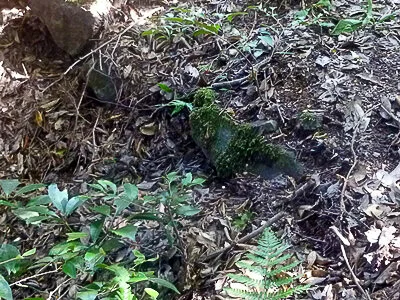
Moss-covered stone walls (石垣 ishigaki).

This section has no moss.

The central part of the main enclosure. It is quite spacious.

One corner of the main enclosure is raised above the surrounding ground, with a stone monument standing on it.

There is a depression along one side of the main enclosure, probably the site of a fortified entrance (虎口 koguchi).

➢ ③ Bizenmaru (備前丸, Bizen enclosure)
During the Nanjō family's rule, this enclosure is said to have housed Nanjō Bizen-no-kami (南条備前守). Buildings and fences stood on a levelled area cut into the ridge.

Remains of stone walls (石垣 ishigaki) around Bizenmaru.

➣ Observation tower
Along the way, an observation tower modelled on a castle turret (櫓 yagura) stood.

View over central Kurayoshi from the observation tower.

➣ ④ Utsubuki Park (打吹公園)
This park at the northern foot of Mount Utsubuki was laid out in 1904 to commemorate Crown Prince Yoshihito's visit to the San'in region. He later became Emperor Taishō (大正天皇, 1879–1926).

➣ Hiryūkaku (飛龍閣)
This building in Utsubuki Park served as the crown prince's residence.

Visited on 11 October 2014
History
The castle is associated with the Yamana family . During the Nanbokuchō period , when rival Northern and Southern courts contested imperial authority, Yamana Tokiuji (山名時氏, 1303–1371) lived in Kurayoshi and held military governorships in five Chūgoku provinces. His son, Yamana Moroyoshi (山名師義, 1316–1376), is traditionally credited with building Utsubuki Castle during the Enbun era and making it his residence. The supplied account dates its construction to between 1358 and 1360. The precise construction date remains uncertain.
By the closing decades of the Sengoku period , Utsubuki Castle had come under the control of the Nanjō family (南条氏), whose principal stronghold was Ueshi Castle (羽衣石城). The Nanjō supported the Western Army in the Sekigahara campaign of 1600. After their defeat, they lost their lands.
In 1614, Satomi Tadayoshi (里見忠義, 1594–1622) was ordered to move from Awa Province to Kurayoshi after becoming implicated in the downfall of the senior shogunal councillor Ōkubo Tadachika (大久保忠隣, 1553–1628). Although formally described as a transfer, the move amounted to exile. Tadayoshi never occupied Utsubuki Castle; instead, he lived at the foot of the mountain. His wife was Tadachika's granddaughter, a family connection that helps explain why his fortunes were tied to those of the disgraced councillor.
The following year, in 1615, the shogunate abolished and dismantled Utsubuki Castle under its "one castle per province" decree (一国一城令). Tadayoshi subsequently lost his remaining lands. He was moved to Shimotanaka village outside Kurayoshi in 1617, then to Hori village in 1619. He died there in 1622, aged twenty-nine by the traditional Japanese reckoning.
According to the local account, eight close retainers followed him in death three months later, committing ritual suicide in an act of loyalty known as junshi (殉死). They became known as the "Eight Worthies" (八賢士), and a tradition links them to the eight heroes of the novel Nansō Satomi Hakkenden (南総里見八犬伝). This proposed connection belongs to the story's later reception rather than being an established account of the novel's origins.
During the Edo period , the Tottori domain maintained the Kurayoshi jin'ya (倉吉陣屋), a local administrative headquarters, at the northern foot of Mount Utsubuki.
Layout and defences
The castle's layout followed the mountain's shape. Its main enclosure, or honmaru (本丸), occupied the summit. Steep slopes on the northern and south-eastern sides provided natural protection and made an approach difficult. To the west, where the terrain spreads into a more complicated network of ridges, numerous small defensive enclosures, known as kuruwa (曲輪), guarded the routes towards the summit.
Map based on the Geospatial Information Authority of Japan's GSI Maps. The locations of enclosures and other castle features are conjectural and may not be accurate.
Map of Utsubuki Castle:
Visit record
I travelled by car that day. The tourist car park at Kurayoshi City Hall was available, but it was full. After searching, I finally found a spot to park near the athletics stadium.
I began the climb at the trailhead near the stadium and followed the route around the mountain's southern side.
➣ ① Mushadamari (武者溜, Warrior assembly area)
➣ ② Honmaru (本丸)
I reached the far end of the main enclosure about 20 minutes after leaving the car park.
A dry moat (空堀 karabori) within the main enclosure.
The earthen bridge (土橋 dobashi) was reinforced with stone along its sides.
Moss-covered stone walls (石垣 ishigaki).
This section has no moss.
The central part of the main enclosure. It is quite spacious.
One corner of the main enclosure is raised above the surrounding ground, with a stone monument standing on it.
There is a depression along one side of the main enclosure, probably the site of a fortified entrance (虎口 koguchi).
➢ ③ Bizenmaru (備前丸, Bizen enclosure)
During the Nanjō family's rule, this enclosure is said to have housed Nanjō Bizen-no-kami (南条備前守). Buildings and fences stood on a levelled area cut into the ridge.
Remains of stone walls (石垣 ishigaki) around Bizenmaru.
➣ Observation tower
Along the way, an observation tower modelled on a castle turret (櫓 yagura) stood.
View over central Kurayoshi from the observation tower.
➣ ④ Utsubuki Park (打吹公園)
This park at the northern foot of Mount Utsubuki was laid out in 1904 to commemorate Crown Prince Yoshihito's visit to the San'in region. He later became Emperor Taishō (大正天皇, 1879–1926).
➣ Hiryūkaku (飛龍閣)
This building in Utsubuki Park served as the crown prince's residence.
Visited on 11 October 2014
Access:
- Address: Utsubuki Castle Ruins, Nakanomachi, Kurayoshi, Tottori 682-0824.
- Access:
By public transport: Take a bus from Kurayoshi Station on the JR San'in Main Line and get off at Shiyakusho Utsubuki Kōen Iriguchi (市役所打吹公園入口). (Bus route map). By car: Approximately 3 km from Kurayoshi Interchange on the Hōjō–Kurayoshi Road via National Route 313. - Parking: Free parking is available at Kurayoshi City Hall and other locations marked 'P' on the map above.

