 1043 reviews ★★★★★ |

 Win a Free flashlight
 Make us your preferred Google source
1lumen selects and reviews products personally. We may earn affiliate commissions through our links, which help support our testing.
Speras PZ21 review

Speras PZ21 Specifications & measurements
| Brand & Model | Speras PZ21 |
|---|---|
| Flashlight category | Zoomable / hunting |
| Battery config. | 1*21700 |
| Switch type | Side |
| Dimensions: | |
| Length | 151-173 mm |
| Head diameter | 48 mm |
| Weight with battery | 254 g |
| LED & Beam | |
| LED type | Luminus SFT42R |
| High CRI | No |
| Focusable beam | Yes |
| Features | |
| Onboard charging | USB-C |
| Power bank | No |
| Specifications and measurements | |
| Specified output | 2,700 lm |
| Measured output (30sec) | 2,543 lm |
| Max. measured output | 2,792 lm |
| Specified beam distance | 900 m |
| Measured beam distance (30sec) | 1,032 m |
| Specified beam intensity | 202,500 cd |
| Measured beam intensity (30sec) | 266,000 cd |
| Overall rating | 4.5 stars |
| Review publication date | August 2026 |

Review intro:
Speras is a flashlight manufacturer focused on high-performance lighting for outdoor, tactical, hunting, and everyday carry applications. After reviewing quite a few Speras lights over the years, I've come to be quite a fan of all things Speras.
After recently reviewing the smaller PZ16, I was interested to see what its bigger brother, the PZ21, could do. It uses the same adjustable zooming concept, allowing you to switch between a broad flood for close-range use and a tightly focused spot for distance.
The bigger PZ21 steps things up to a 21700 battery, onboard USB-C charging, and claimed performance of 2700 lumens and an impressive 900 meters of throw. Seeing all of this, I had pretty high expectations for this even-larger "zoomie". Sometimes you need to light up everything nearby, and sometimes you need to see what is waaaaay over there.
Before first use, remove the battery insulating film and charge up that included 21700 and you're ready to go!
What's in the package
The PZ21 arrives in the same familiar Speras white box with yellow highlights and a full-color image of the flashlight on the front, just like the PZ16. Inside, the flashlight and accessories are packed neatly and protected by a cardboard wrap. The package includes everything needed to get started, and I don't see any major accessories missing.
Here is everything included:
- Speras PZ21 Zoomable Flashlight
- 4800mAh 21700 rechargeable Li-ion battery
- USB-C charging cable
- Lanyard
- 2 spare O-rings
- User manual


Flashlight in use, Build Quality, and Warranty
The PZ21 feels great in hand and is actually much lighter than I was expecting for a flashlight with such a large head. The handle itself is fairly slim and completely smooth, without any knurling or additional milling for grip at the main handle portion. The large bezel and zoom assembly put slightly more weight toward the front, but the flashlight still balances surprisingly well and feels comfortable to hold.
The body is constructed from 6061 aluminum alloy with a black anodized finish. The square-cut threads are also anodized and were slightly lubricated from the factory. Overall, the machining and fitment on my sample look and feel very good.
Operation is handled by an electronic side switch positioned near the head. There is no tail switch, just the single side-switch with its LED indicator in the center. We'll get into exactly how the switch and indicator operates later in the UI section.
The standout feature is, of course, the adjustable zoom system. Twisting the large head transitions the beam between a broad flood for close-range illumination and a tightly concentrated spot for distance. The beam can also be adjusted anywhere between the two extremes depending on the task at hand.
The PZ21 is considerably larger than the PZ16 and isn't really what I would consider a pocket-carry flashlight. There is no pocket clip or holster included which makes carrying a little more picky. The included lanyard is fairly basic and feels a bit cheaper than I would have expected for a light like the PZ21, but it attaches at the tail and provides a useful way to secure the light while carrying it.
The bezel is completely round with no real anti-roll feature, so the PZ21 will happily roll away if placed on its side. The flat tail allows it to tail stand securely. The tailcap is slightly recessed with a built-in lanyard holes around the ring of said tailcap. The is no magnet due to this design. I feel like a zoomie light doesn't necessarily need to tailstand so I don't mind this too much.
With its combination of a wide flood and long-range focused beam, the PZ21 is particularly well suited for hunting, spotting, camping, property inspection, and general outdoor use. The larger 21700-powered format makes more sense for these uses than everyday pocket carry, especially when you want both broad area lighting and serious reach from one flashlight.
WARRANTY INFO:
Speras provides 30-day free replacement coverage for manufacturing defects. If a problem develops within the first 30 days of purchase, Speras will repair or replace the flashlight with the same model.
The PZ21 is also covered by five years of free repair for problems that develop during normal use. After five years, Speras offers limited-lifetime repair service, with the customer responsible for the cost of replacement parts.
Warranty requests should first be directed to the seller or dealer with the warranty card, purchase invoice, receipt, or other proof of purchase. Coverage excludes normal wear, damage caused by disassembly or modification, rough operation or misuse, improper maintenance, and repairs performed by anyone other than Speras or an authorized retailer.


LED/LEP/HID, Lens, Bezel, Reflector, and Beam
The PZ21 uses a Luminus SFT42R, the same high-intensity, throw-oriented LED used in the smaller PZ16. The SFT42R is a domeless emitter that uses Luminus's round-die technology, giving it a circular emitting surface rather than the more typical square shape. Its combination of high output and high intensity make it particularly well suited for throw-oriented applications as in this case, a zoomie!
Instead of a conventional smooth or orange-peel reflector, the PZ21 uses a large convex lens and adjustable zoom mechanism. Twisting the head transitions between a broad flood beam and a tightly concentrated spot, with the beam adjustable anywhere between the two. There is no TIR optic or conventional reflector thanks to that large lens. Speaking of the large convex lens, it sits inside a simple, completely round aluminum bezel with no aggressive crenulations or strike points.
In its fully flooded position, the PZ21 produces a broad and even wall of light with a very slight halo around the outer edge. Fully focused, the beam becomes a perfect tiny circle that is considerably more intense and designed for reaching way out there. There is also a very faint square artifact from the SFT42R that can be seen if you're specifically looking for it, but it is much less noticeable during normal outdoor use. Both flood and spot appear fairly white to my eyes without any obvious green tint.
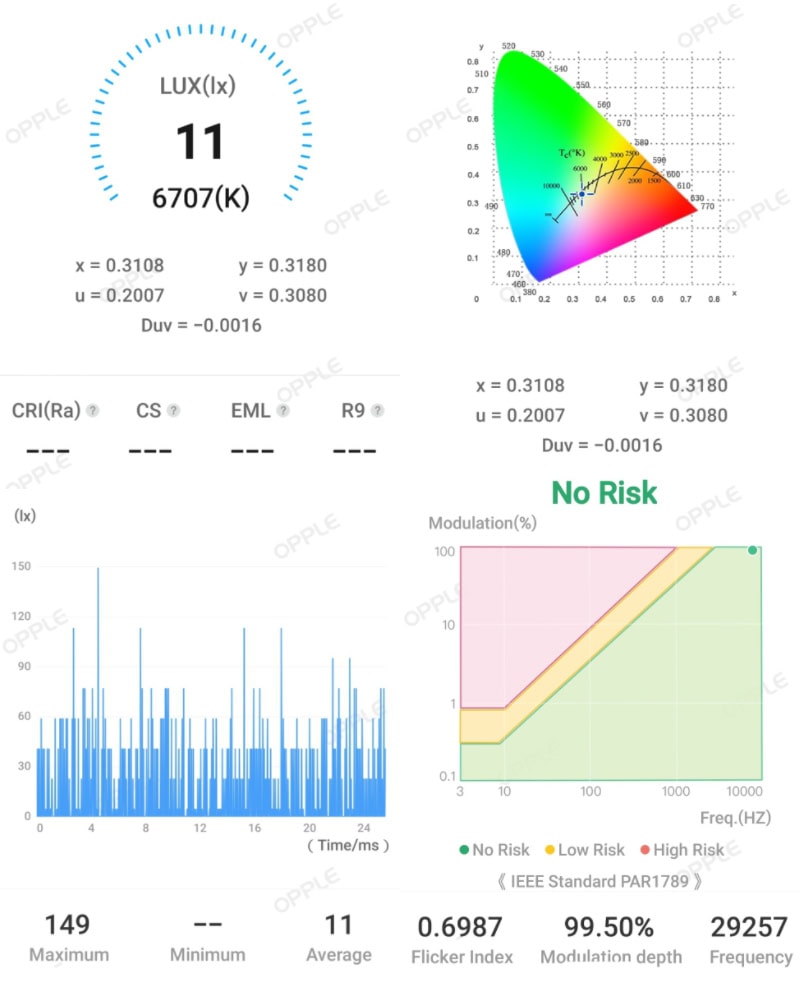
Speras does not specify a color temperature, but my Opple Light Master IV measurements ranged from 6012 K to 6707 K, putting the PZ21 firmly into cool-white territory. All five measurements produced a negative DUV, ranging from -0.0004 to -0.0046. A negative DUV places the tint below the Planckian locus (BBL), indicating a tendency away from green and toward a slightly rosy tint. CRI Ra could not be measured by the Opple during these tests.
More details:
- LED Type: Luminus SFT42R
- High CRI: No
- Focusable beam: Yes
Spectral measurements:
Measurements were taken using an Opple Light Master IV to measure the flashlight beam in complete darkness at 10 meters away using the included fully charged Speras 21700 4800mAh Li-ion battery.
| Mode: | CCT: | CRI Ra: | duv |
|---|---|---|---|
| Low Spot | 6707 K | – | -0.0016 |
| High Spot | 6346 K | – | -0.0021 |
| Turbo Spot | 6012 K | – | -0.0004 |
| High Flood | 6441 K | – | -0.0027 |
| Turbo Flood | 6198 K | – | -0.0046 |




Dimensions and its competition
Dimensions:
| Dimensions | Millimeters | Inches |
|---|---|---|
| Length (shortened - flood) | 151 mm | 5.9 in |
| Length (extended - spot) | 173 mm | 6.8 in |
| Head diameter | 48 mm | 1.9 in |
| Body diameter | 25 mm | 1 in |
Dimensions are rounded to the nearest millimeter and the nearest tenth of an Inch.
Weight:
| Weight | Weight in grams | Weight in oz |
|---|---|---|
| Without battery: | 182 g | 6.4 oz |
| With battery | 254 g | 9 oz |
Weight is rounded to the nearest gram and tenth of an Oz.
Flashlight size comparison with its competition:
Group 1: Speras PZ21, Speras PZ14, Speras EST30, Speras EST16


UI : User interface and driver
The PZ21 uses a single electronic side switch for all operations. From off, a single click turns the flashlight on in the memorized mode, while another single click turns it off. While on, press and hold the switch to cycle through Low, Medium, and High, then release the switch at the desired output.
Eco has its own shortcut from off with a 0.5-second hold. Turbo can be accessed from either off or on with a double click, and a single click from Turbo turns the flashlight off. Strobe can be accessed from any state with three rapid clicks. Three more rapid clicks from Strobe switches to SOS, while a single click from Strobe or SOS returns to the state used before entering Strobe.
The PZ21 also features mode memory, returning to the memorized mode when turned on normally.
Electronic lockout is activated from off by pressing and holding the switch for 2 seconds. The flashlight first enters Eco and then turns off and locks. To unlock it, rapidly click the switch three times. The main LED flashes twice to confirm either locking or unlocking. While locked, a short press causes the orange indicator LED to flash for 2 seconds as a reminder that the flashlight is locked.
UI Behavior when OFF
- Single click: On in memorized mode
- Press and hold 0.5 seconds: Eco
- Double click: Turbo
- 3 fast clicks: Strobe
- Press and hold 2 seconds: Lockout
UI Behavior when ON
- Single click: Off
- Press and hold: Cycle Low → Medium → High, release to select
- Double click: Turbo
- 3 fast clicks: Strobe
From Turbo
- Single click: Off
- 3 fast clicks: Strobe
From Strobe
- 3 fast clicks: SOS
- Single click: Return to the state used before entering Strobe
From SOS
- Single click: Return to the state used before entering Strobe
Mode memory
- Yes. The manual states that the flashlight turns on in the memorized mode
Shortcuts:
- To Eco: Press and hold for 0.5 seconds from off
- To Turbo: Double click from off or on
- To Strobe: 3 fast clicks from any state
- To SOS: 3 fast clicks to enter Strobe, then 3 fast clicks again
Lockout
- From off, press and hold for 2 seconds to lock
- The flashlight will enter Eco first and then turn off
- From the locked state, 3 fast clicks unlocks the flashlight
- The main LED flashes twice when locking or unlocking
- While locked, a short press causes the orange indicator LED to flash for 2 seconds
Unscrew to lock-out:
- Yes - ¼ turn will break battery contact
PWM
- None noticeable to eyes - see spectral measurements below
Additional/summary info on the UI:
- Eco: Hold 0.5 seconds from off
- Turbo: Double click from off or on
- Strobe: 3 fast clicks from any state; 3 more for SOS
- Lockout: Hold 2 seconds from off; 3 fast clicks to unlock

Charging and batteries
The PZ21 is powered by a single 21700 Li-ion battery and includes a Speras 21700 cell rated at 4800mAh. Unlike the PZ16, which puts the USB-C charging port directly on its included battery, the PZ21 has onboard charging built into the flashlight. The PZ21 can also be operated while charging, although only Eco mode is available.
The USB-C charging port is located on the flashlight body beneath a rubber protective cover. During charging, the indicator light in the switch is red and changes to green once charging is complete. An orange indicator signals that the battery is incorrectly seated or there is a battery fault. Speras specifies a charging time of approximately 3.5 hours.
I completed multiple charging tests from empty to full, with an average charging time of approximately 3 hours and 33 minutes, almost exactly matching Speras's 3.5-hour specification. During these tests, my USB tester recorded maximum readings between 5.131V and 5.235V, 1.673A and 1.796A, and 7.811W and 8.455W.
Speras specifies low-voltage protection at approximately 2.8V, at which point the flashlight shuts down to protect the battery.
The PZ21 also has a battery level indicator built into the side switch. When the flashlight is turned on, the indicator displays the approximate remaining capacity for 5 seconds:
Battery level indicator:
- Green: 70–100%
- Orange: 30–70%
- Red: 10–30%
- Flashing red: below 10%
| Batteries | Details |
|---|---|
| Compatible batteries | 21700 Li-ion, flat-top or button-top |
| Incompatible batteries | Non-21700 batteries |
| Low voltage protection/warning | blinking red light |
| Onboard Charging: | |
| Onboard charging | USB-C |
| Power bank functionality | No |
| USB-C to USB-C charging | Yes |
| Max power of USB charger (port) | 18 watts |
| Max power measured | 8 watts / 5V / 1.6A |
| Final battery voltage (charged) | 4.2V |
| Avg. onboard charge time | 3h 33min |


Performance test
Andru uses the following equipment for his flashlight testing and reviews
| Type | Gear | Buy |
|---|---|---|
| Light integrator | 50cm styrofoam integrating sphere | - |
| Light output (lumens) | Reed R8100SD | Amazon (local) |
| Light intensity (candelas) | Dr. Meter LX1330B | Amazon (local) |
| DMM | W2972 DMM | - |
| CRI meter (spectro) | Opple Light Master IV | Amazon (local) |
| Distance 1 | Bosch GLM20 | - |
| Distance 2 | RockSeed Digital | Amazon (local) |
| Temperature | T400A Digital Infrared Thermometer | - |
| Scale | Casio | - |
| Calipers | Adoric 0-6" Calipers Measuring Tool | Amazon (local) |
| Battery charger | Vapcell S4 Plus | Amazon (local) AliExpress (intl.) |
| USB meter | - | - |
| Camera | Canon EOS 4000D / T100 | Amazon (local) |
Lumen measurements
How Lumens are Measured: Understanding ANSI FL1 Standards
About Lumen measurements: The ANSI FL1 standards specify that output in lumens should be measured 30 seconds after turning on, as this is the standardized time for measuring brightness according to the industry standard. This is why we focus on this part in our measurements. The ANSI FL1 standards require an ambient temperature of 22 ± 3°C. We record the ambient the ambient temperature to identify potential reasons for any observed discrepancies.
Lumen measurements were taken using my 50cm homemade integrating sphere (IS) and a REED R8100SD Data Logging Light Meter (with a measurement range up to 100,000 Lux). The IS has been calibrated using a 1lumen.com calibrated S2+ as a comparable reference source and the included fully charged Speras 21700 4800mAh Li-ion battery.
| Mode | Specified output | Turn on | 30 sec. | 10 min. |
|---|---|---|---|---|
| Eco | 5 lm | 7 lm | 7 lm | 7 lm |
| Low | 100 lm | 110 lm | 110 lm | 109 lm |
| Med | 400 lm | 367 lm | 365 lm | 365 lm |
| High | 1,000 lm | 905 lm | 891 lm | 385 lm |
| Turbo | 2,700 lm | 2,792 lm | 2,543 lm | 416 lm |
*Turn-on and 30 second measurements are done manually, while the 10-minutes readings comes from the runtime graph. This is our standard approach, though some reviewers may choose a different approach.
Ambient temperature during testing:
- 20.5°C
Battery Life: Runtime graphs
How Runtimes are Measured: Understanding ANSI FL1 Standards
About ANSI FL1 runtime standards: The runtime is measured until the light drops to 10% of its initial output (30 seconds after turning on). This does not mean that the flashlight is not usable anymore. The last column shows how long the light actually works till it shuts off. If there is a + symbol, it means that the test was stopped at that particular point, but the light was actually still running. This happens on certain occasions, with certain drivers, firmware, or batteries.
Runtimes were measured using the REED R8100SD Data Logging Light Meter (with a measurement range up to 100,000 Lux) and the included fully charged Speras 21700 4800mAh Li-ion battery.
| Mode | Specified runtime | Runtime (ANSI FL1) | Time till shut off* |
|---|---|---|---|
| Eco | 500h 00min | n/a | n/a |
| Low | 27h 00min | n/a | n/a |
| Med | 4h 00min | 4h 17min | 4h 43min |
| High | 3h 18min | 4h 02min | 4h 02min |
| Turbo | 3h 00min | 3h 28min | 3h 33min |
*The last column reflects the total runtime until the light turns off. A "+" symbol indicates that the test was stopped at that point, but the light continued to run. This typically occurs with certain drivers, firmware, or battery types.
Runtime performance was excellent, with every tested mode exceeding SPERAS's specified ANSI FL1 runtime. Medium ran about 7% longer than claimed, while High was especially impressive at roughly 22% longer. Turbo also beat its 3-hour specification, reaching 3 hours and 28 minutes, or about 16% longer than claimed. Overall, the PZ21 delivered better runtime performance than expected across every mode I tested.


Peak beam intensity and beam distance measurements
About Peak beam intensity: Understanding ANSI FL1 Standard
About peak beam intensity: The calculated value of distance in meters at which the flashlight produces a light intensity of 0.25 lux. (0.25 lux is about the brightness of a full moon shining on an object). This means that the intensity has decreased so much, it becomes difficult to see darker objects, or objects that don't reflect light. The columns ‘Meters’ and ‘Yards’ use rounded numbers.
Throw measurements were taken outdoors in complete darkness at 10 meters using a Dr. Meter LX1330B Digital Illuminance Light Meter, with a 0-200,000 measurement range for accurate lux readings, converted to candela. All measurements were taken at 30 seconds for most accurate measurements in accordance with ANSI measurement ratings.
| Mode | Specified intensity | Specified beam distance | Candela measured | Meters | Yards |
|---|---|---|---|---|---|
| Low | 7,500 cd | 173 m | 11,100 cd | 211 m | 231 yd |
| Medium | 31,750 cd | 356 m | 38,500 cd | 392 m | 429 yd |
| High | 79,000 cd | 562 m | 82,800 cd | 575 m | 629 yd |
| Turbo | 202,500 cd | 900 m | 266,000 cd | 1,032 m | 1,129 yd |
Ambient temperature during testing:
- 28°C
The PZ21 performed extremely well in my throw testing, exceeding SPERAS's specifications at every tested output level. Low came in about 48% above specification, Medium about 21% higher, and High was very close at roughly 5% above spec. Turbo was the standout, producing about 31% more intensity than claimed and exceeding the specified beam distance by nearly 15%. Overall, throw performance was excellent across the board.

Beamshots
Beamshots were taken using a Canon EOS 4000D. Settings as follows:
- ISO 1600, 1/4sec., f/10, WB - “AWB ambience priority”
- Distance to fence is 28m
Beamshots of the following flashlights compared:
Please note that the following beamshots are mainly intended to showcase the beam pattern and beam quality, rather than overall performance. These images are typically taken directly after activation, and in different seasons or weather conditions, and therefore do not fully represent its overall performance. In few cases the camera settings are even different and therefore not meant for performance comparisons. For accurate performance metrics, such as output, beam distance, and runtimes, you need to look at the performance section of this review.


Disclaimer: This flashlight was sent to us for review at no cost by SPERAS. We have not been paid to review, nor have we been holding back on problems or defects.

Final Verdict
 Pros
+Excellent throw performance, exceeding specifications at every tested level
+Strong runtime performance, exceeding specifications in every mode tested
+Very versatile flood-to-spot zoom system
+Good build quality with onboard USB-C charging
 Cons
-Completely round head has no anti-roll protection
-Smooth body provides relatively little grip
 Considerations
Large 48mm head makes it better suited to outdoor carry than pocket EDC.
No pocket clip or holster included.
Included lanyard feels cheaper than the rest of the package.
Cool-white, non-high-CRI output.
Explanation on star ratings:
1: Avoid: my phone flashlight would be a better choice - 2: Poor: significant defect or issues; almost unusable - 3: Average: some defects or issues; but still usable 4: Good: recommended (minor issues) - 5: Great: highly recommended

4.5 stars: ★★★★⋆
Note: Our star ratings serve as a general guide, but we advise against placing too much emphasis on individual scores. Each reviewer brings their own perspective, and there is no standardized scoring system to reflect the intricate preferences of all flashlight users. Read the full review to help you make your decision, focusing on the overall performance and the features that matter most to you.
The PZ21 turned out to be a very impressive bigger brother to the PZ16. It takes the same useful flood-to-spot concept and steps things up with a larger 21700 battery, onboard USB-C charging, more output, and considerably more reach. Despite the larger head, it is also lighter in hand than I expected and feels well built overall.
Performance was probably the biggest surprise. My sample exceeded SPERAS's throw specifications at every tested output level, with Turbo especially impressive at about 31% above the claimed intensity and nearly 15% beyond the advertised beam distance. Runtime performance was just as good, with every mode I tested exceeding its specified runtime. Output was also respectable, with Turbo actually exceeding its 2700-lumen claim at startup and still producing about 94% of specification at 30 seconds.
There are a few things I would change. The completely round head could really use some anti-roll protection, the smooth body doesn't provide much grip, and for a light this size I would have liked to see a holster included. The supplied lanyard also feels a little cheap compared with the otherwise good build quality. None of those issues significantly affect what the PZ21 is designed to do, though, and considering its build quality, features, and especially its measured performance, I'm giving the SPERAS PZ21 4.5 out of 5 stars.
For hunting, spotting, property inspection, camping, or simply having one flashlight that can provide a wide flood one minute and reach way out there the next, the PZ21 works extremely well. The PZ16 impressed me, but the PZ21 takes that same idea and adds the battery capacity, charging convenience, output, and especially the throw I would expect from its larger size. Sometimes bigger really does mean better, especially when you can focus it over a kilometer away!
Get 10% off at Speras store with our unique coupon code: LUMEN
1lumen selects and reviews products personally. We may earn affiliate commissions through our links, which help support our testing.