 1042 reviews ★★★★★ |

 Win a Free flashlight
 Make us your preferred Google source
1lumen selects and reviews products personally. We may earn affiliate commissions through our links, which help support our testing.
Fireflies E12 Eclipse review

Fireflies E12 Eclipse Specifications & measurements
| Brand & Model | Fireflies E12 Eclipse |
|---|---|
| Flashlight category | High Output Enthusiast |
| Battery config. | 1*21700 |
| Switch type | Side |
| Dimensions: | |
| Length | 117 mm |
| Head diameter | 49 mm |
| Weight with battery | 251 g |
| LED & Beam | |
| LED type | 12*Luminus SFT-25R |
| High CRI | No |
| Focusable beam | No |
| Features | |
| Onboard charging | USB C |
| Power bank | Yes OTG |
| Specifications and measurements | |
| Specified output | 15,000 lm |
| Measured output (30sec) | 2,370 lm |
| Max. measured output | 9,717 lm |
| Specified beam distance | 700 m |
| Measured beam distance (30sec) | 326 m |
| Specified beam intensity | N/A |
| Measured beam intensity (30sec) | 26,617 cd |
| Overall rating | 5 stars |
| Review publication date | May 2026 |

Review intro:
Fireflies (or FireflyLite? Pick your poison I guess) has been around since 2017, and when they went public in 2018, they basically turned the flashlight ecosystem on its head. Their first lights, the ROT66 was unlike anything else the flashlight hobby had seen (Hank's Noctigon M43 Meteor came soon after).
It was revolutionary for their day, with nine exotic Nichia 219b R9080 LEDs nobody except those with obscure tribal LED knowledge had heard of, advanced drivers with a special UI, and a compact form factor. Prior tp the ROT66, if you wanted a soda can light with lots of Lumens, you'd be grabbing a humongous Haikelite product.
However, this flashlight was different, and the subsequent E07 (and PL47 series), pushed the limits of what was previously possible outside heavily modded lights. It could be said that Fireflies helped spur on the enthusiast movement, and along with a small number of other brands, keeps it alive and well today.
Despite some rough spots with quality control early on, then issues with logistics and product launch delays during the coronavirus pandemic, they resurrected themselves as FireflyLite and launched improved versions of the E07 (the Canon), and many new ones (the L series, E90, E04, X series, etc.), with each release delivering new features and upgraded performance.
I've thoroughly enjoyed this Renaissance in the Fireflies camp, and riding that exuberance, they've resurrected one of their more popular offerings, the E12R.
The E12R was a 12-LED TIR-based throw-flood high Lumen machine, their highest-output, highest-end offering when launched. The original was awesome, but was discontinued way too soon. Fireflies re-launched it as the E12C with a FET driver, but when the E12C was discontinued, Fireflies was left with a gaping hole in their portfolio.
What to do? Well, make a new one, and that new one is finally here, and I've got one for review. This new E12 Eclipse has a brand new host, more output, new LEDs, a new driver, and Anduril 2.
What's in the package
The E12 Eclipse comes in the standard, somewhat-boring FireflyLite box typical of their newer lights. It’s not fancy (even for an upper class budget light), but functional. A fold open lid reveals a lot of stuff, well protected in cut light density foam. Here’s what I got:
- Fireflies E12 Eclipse
- TenPower 50XG tables 5000 mAh 21700 (loaded in the light)
- Lanyard
- Spare o-rings
- Pocket clip
- Lanyard ring (installed)
- User guide
This is typical of Fireflies loadouts; enough kit to get you going, although the battery is optional (I recommend you get it-it's a low-cost add on). Fireflies bundled the TenPower 50XG with the light, which is one of the higher-end tables cells today. It was charged to 3.55 volts, perfect for storage, but even at that low voltage, it still provided plenty of light out of the box. The familiar and most-disliked Slinky-like lanyard is back, and you get a stainless clip as well that can be installed.


Flashlight in use, Build Quality, and Warranty
The E12 Eclipse builds on the prior E12R's success as a multi-LED, high performance enthusiast light. Could it be a general purpose light? Sure, but there are much better options out there. It's not an EDC piece, although you could pocket it pretty easily.
For the output, the Eclipse is actually pretty compact at under five inches long and pretty lightweight. Size-wise it's similar to a Convoy M21K or Fireflies own E04 Surge. Handling is solid for a light of this type, and it's enjoyable and easy. I sometimes forgot I was holding a 15,000 Lumen capable light!
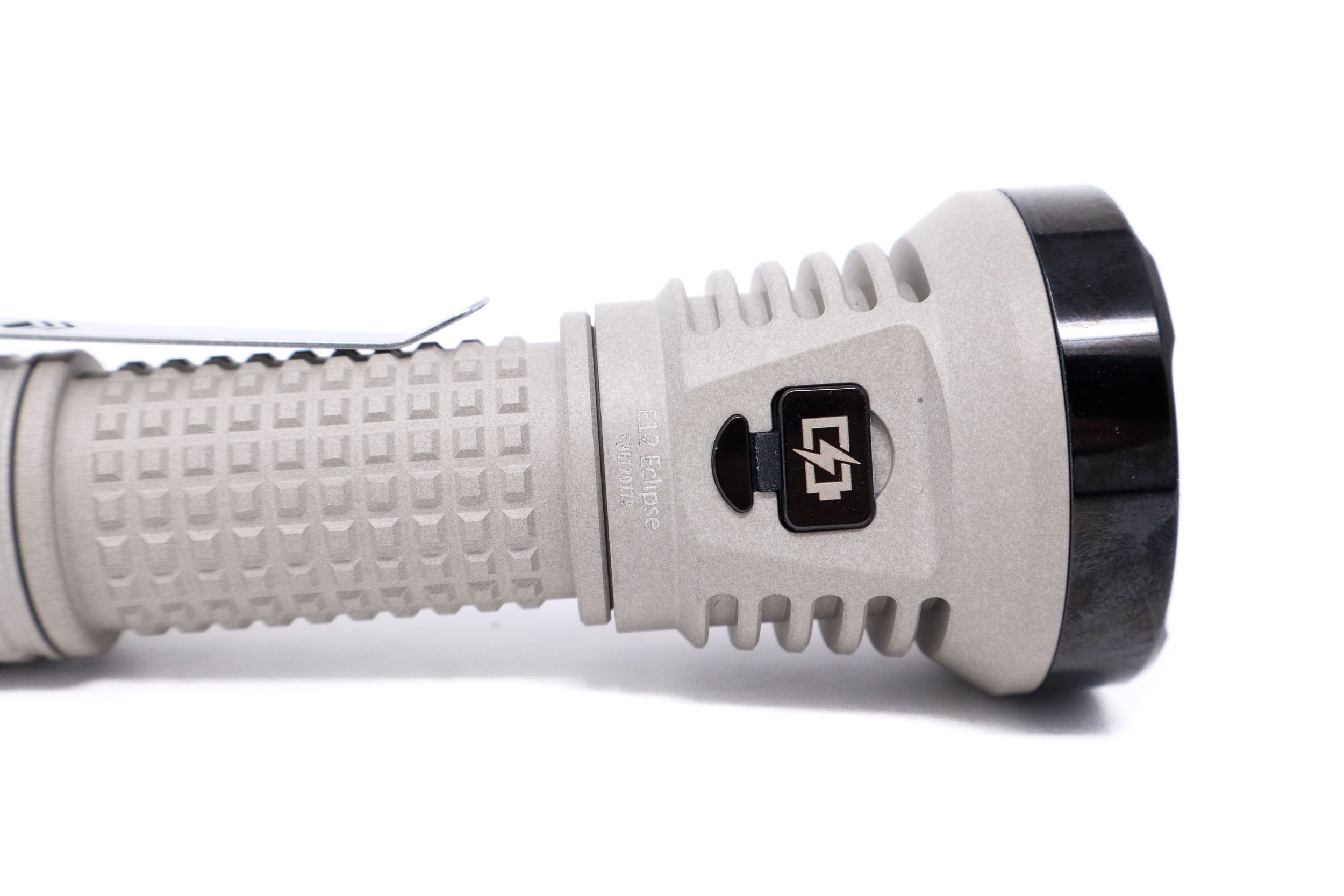
The host for the Eclipse is also new, but still incorporates design elements and features of other Fireflies lights. The host itself is well designed and looks great, a nice melding of form and function. The head is new, and looks similar to the E90 Blaze, but it's smaller and much more compact, closer in size to the E04.
The tube follows the design of the E04, with a two-piece tailcap consisting of the main cap and a smaller cap that unscrews allowing access to a removable donut magnet. It sits in a cutout that's rubber lined to keep it from rattling around, which I like, and I really appreciate that it can be removed if desired.
The smaller 'cap' for the magnet also secures the stainless steel lanyard loop or pocket clip. This is also another feature I really like since you don't have to unscrew the whole tailcap to swap the ring or clip like the earlier E-series lights.
The tube itself has the same blocky knurling as the other E-series, and the tailcap has the same, but shallower. The smaller cap has cuts on the periphery for grip, and it is flat for tailstanding. The magnet is pretty stout, able to hold the loaded E12 at a 90 degree angle, but a good solid piece of metal is required since it's pretty top heavy.
Other retention methods include holes for the lanyard in the pocket clip and a ring that's only for the lanyard. The clip is a one-way captured design identical to the other E-series, with a laser-cut Fireflies logo on the heel.
It's sturdy stainless steel, and has a good amount of clip tension to it. The head layout is similar to the other E-series lights also, with a single head mounted e-switch opposite the Fireflies-patented magnetic USB C port.
The e-switch is standard Fireflies. The button and bezel are glossy PVD coated blackened stainless steel with a central LED indicator with (UI configurable) AUX LEDs underneath. I really like these switches.
The action is excellent; not too stiff, not too light, with just the right amount of tactile feedback for easy clicking. That's important on an Anduril 2 light because you'll do a lot of clicking (trust me), and a nice switch makes all the difference. The button has circular reeding for a nice gripping surface as well.
The USB C port cover is also stainless steel and has the same glossy black PVD coating treatment as the switch and switch bezel. The cover has embedded magnets and flexes on a sturdy rubber hinge. It snaps closed and stays planted smartly, and didn't dislodge unless I really tried to. There's no obvious sealing surface, so the port itself must be weatherproofed?
For build quality, Fireflies just keeps getting better. The first E-series were a mixed bag of excellent to so-so quality control, with some way-too-big o-rings or too-small o-ring gloves resulting in tubes and tailcaps that required Lou Ferrigno-levels of hand strength to unscrew (even with lube).
Subsequent releases nixed that issue, and I'm happy to report no major build or quality control issues with the Eclipse. The level of quality is totally appropriate for a limited-production flashlight.
The main tailcap on my sample is a bit tough to unscrew, even with extra lube, but it probably needs time to loosen up. I recommend changing batteries from the head anyway since the pocket clip (if installed) drags on the tube when unscrewing it.
Pricing for the E12 Eclipse starts at an MSRP of $128 US for the base configuration with Fireflies branded (FFL) LEDs, but upgrading to Nichia LEDs adds $20 and Luminus LEDs adds $25. Adding a battery adds another $10, so a fully optioned Eclipse will set you back $163 with the battery.
That's a lot of money for sure, but not a bad deal for what this is (12 LEDs, remember), and the price is reasonable considering there really aren't any competitors at this level.
The host is milled from some kind of high grade aluminum alloy (Fireflies doesn't say, but it used to be 6063), and the machining is very sound and well done. There's no abrupt edges and no anomalous gaps or misaligned parts either.
As mentioned, every removable part was easy to remove. For the finish, you have some options, four at the moment. My sample came in Fossil Grey MAO, but you can get black, Ember Red, or Navy Blue anodizing.
The MAO grey finish is nice and seems durable as far as MAO's go. I haven't had the best luck with these finishes (for any manufacturer), but this one's held up well. It's grippy and evenly applied and looks amazing with the PVD blackened bezels and switch.
The light can be completely disassembled: The bezel unscrews by hand, the tube comes off, and the tailcap unscrews easily. The TIR optic pops out with light persuasion, and the MCPCB (with AUX LED board on top) is screwed to the LED shelf.
The solder and reflow looks awesome and all the LEDs are aligned perfectly in their pads. The threads for the tube front and back are fully anodized and rectangular cut with a single o-ring groove. The tail threads are very short and needed just 1-1/4 turns to tighten.
For MAO, the threads are smooth, but weren't lubed much, so some SuperLube was helpful in smoothing things up. The bezel and outer tail cap have much finer triangular cut threads, and the main sealing surfaces are o-ring sealed, but the outer cap has no sealing o-ring (not needed).
The E12 Eclipse doesn't specify an ingress protection rating. There's two springs at work here, and the spring configuration is part of the design changes Fireflies made.
The driver now has a post and spring as opposed to a coil spring. The spring sits in a cup on the short post, and has been widened for a larger contact area. The springs are still high current BeCu with silver plating for low resistance.
The driver spring is meant to be fully compressed during operation to both lower the DCR (resistance) and reduce compressive load on the battery positive terminal (to keep it from denting). The tail spring is a new design, featuring a flat silver plated contact for a better contact patch. The spring is also stiffer to provide consistent pressure.
No IP rating is specified for the Eclipse, but we can assume that it's just as water resistant as the other Fireflies, maybe IPX6 for light misting or splashes of water, but full immersion is not recommended.
For the warranty, from Fireflies: We provide 3 years' manufactory warranty to fireflies flashlights. (Consumable batteries are not in warranty. ) DOA products can be returned and refunded within 15 days, We will bear all the returning shipping cost.




LED/LEP/HID, Lens, Bezel, Reflector, and Beam
Part of the allure of Fireflies lights, and what keeps them in the enthusiast circle's eye is the generous LED choices offered with their flashlights. The E12 Eclipse is no different, and has a pretty deep bench of LEDs in various CCTs and CRI levels.
At the time of this writing, there's eight LED choices available, the vast majority being the FFL315A in five CCTs (5000-1800K 90 CRI, rosy in between). There's two varieties of Luminus SFT-25R as well (6500, 5000K) and a lone Nichia 519A offering, 4000K. Since I want the highest-output potential for the sample, I opted for the Luminus SFT-25R in 6500K.
The SFT-25R needs little introduction. It's a 3535 size XP footprint with a round LES (the 'R') measuring 2.25 mm2 and has excellent power-handling abilities and solid output for a small LED.
The current 25Rs are all cool white 5000-6500K low CRI, and does get green at lower outputs and still suffers from the tint shift like other SFT models, but for the intended purpose, it's a great, affordable option for smaller optic and reflector-based lights.
Like the other E12s, the Eclipse uses 12 LEDs wired in parallel behind a custom made TIR optic. The optic is secured with a stainless bezel with wide, flat crenulations. The bezel is very finely polished and PVD coated black to match the switch and switch bezel.
It looks awesome, and combined with the dual AR-coated optic (which Fireflies says is good for 98% transmittance), offers good protection to the optic.
The plastic optic is a homogenous 12 lens unit that positions the individual optics to focus the beam into a very effective spot and flood output. There's lots of diffuse spill and side illumination with a soft transition to the focused hotspot (for my LED choice; the FFL or Nichia LEDs may have a larger hotspot).
There's a lot of beam distance available here, but in person, it's not super impressive, but still for a small light it's awesome. Of note, I thought Fireflies sent me the wrong LEDs because the CCT seemed warmer than it was, but the Opple confirmed these are 6000-6500K. The angular (visible) green-yellow corona of the domed SST LEDs is not super evident here, and the tint wasn't bad at all.
More details:
- LED Type: Luminus SFT-25R
- High CRI: No
- Focusable beam: No
Spectral measurements:
I used a Opple Lightmaster Pro to measure the flashlight at 2 meters distance.
| Mode: | CCT: | CRI Ra: | duv |
|---|---|---|---|
| Turbo | 6312K | 68.1 | 0.0041 |
| L2 | 5439K | 64.9 | 0.0096 |


Dimensions and its competition
Dimensions:
| Fireflies E12 Eclipse | Millimeters | Inches |
|---|---|---|
| Length | 117 mm | 4.6 in |
| Head diameter | 49 mm | 1.9 in |
| Body diameter | 26 mm | 1 in |
Dimensions are rounded to the nearest millimeter and the nearest tenth of an Inch.
Weight:
| Fireflies E12 Eclipse | Weight in grams | Weight in oz |
|---|---|---|
| Without battery: | 180 g | 6.4 oz |
| With TenPower 50 XG battery | 251 g | 8.9 oz |
Weight is rounded to the nearest gram and tenth of an Oz.
Flashlight size comparison with its competition:
Group 1: Fireflies E04 Surge, Fireflies E07X Canon, Fireflies E12 Eclipse, Fireflies E07 2021, Fireflies X4 Stellar
Group 2: Cyansky P50R, Astrolux MF01 Mini, Fireflies E12 Eclipse, Nightwatch A54U, Imalent R30C
Group 3 optics: Fireflies E04 Surge, Fireflies E07X Canon, Fireflies E12 Eclipse, Fireflies E07 2021, Fireflies X4 Stellar


UI : User interface and driver
Part of the upgrades the E12 Eclipse brings to the table is the brand-new driver. It's still a FET+buck unit, and still a product of driver genius Loneoceans, the Lume10. This is a dual channel driver based on the Lume1 driver found in other E series lights, but it's been tweaked somewhat from the prior Lume1 design. The dimensions are identical, with onboard USB C charging. The Lume10 retains the same AVR32DD20 MCU as the newer Lume X1 and the 3-pin UPDI flashing interface.
The upgrades for the Lume10 include a constant current output bump to 10 amps (from 6), and adds an OTG (on the go) reverse charging (power bank) feature similar to the X4 Stellar (accessed in momentary mode).
The driver spring arrangement is also new. The UI is the same Anduril2 with the UDR (ultra dynamic range), but also adds a new Advanced AUX LED control feature, for extra customization of the AUX LEDs that goes way beyond the previous RGB AUX (more details below in the Summary).
Additional/summary info on the UI:
- The E12 Eclipse shipped with Advanced Mode enabled. To switch it back to Simple, click ten times from OFF.
- The Lume10 driver firmware for Anduril 2 came with the latest Anduril version, so 07-07-2025, but the similarities stop there because the Lume10 driver has a unique firmware for Fireflies and the version check will throw all but the most flashlight UI savvy folks into confusion.
- Part of this is the Advanced AUX control for the AUX LEDs, which Loneocean explained to me. Current Anduril 2 drivers rely on the Anduril firmware for that functionality, but Advanced AUX uses a separate MCU (the Atmel TWI) for control in the form of an RGB LED controller. Why? We all know that AUX LEDs in other Anduril drivers (even Liume1, X1) run off the MCU and introduce parasitic drain, and at the high end it can be as much as 35 mA. That's a lot, so the goal with Advanced AUX was to increase the configurability and decrease the standby power draw, which Loneocean says is down to 100-150 µA. You can still configure the AUX LEDs to get bright (4 mA up to 30 mA), but with 4-bit analog and 8-bit PWM control. This gives you lots of options for tweaking (as if Anduril 2 needed more?) the AUX LEDs to do what you want without resorting to hardware changes (like resistor swaps) for brightness changes.
- The temperature sensor is precalibrated (all Anduril 2 lights should be precalibrated) to within +/- 1-2° C.and the thermal limit (for the E12) is 50 C. This is a bit low, so I recommend bumping it up to 55 (or 60 if you're brave) C. LVP is also extremely consistent, set to 2.9 to 2.8 volts under load, so your batteries won't degrade.
Anduril 2 Multi Channel User Interface
Disclaimer: This is a standardized Anduril 2 Multi Channel UI template. Anduril 2 has received multiple updates over the years. Some manufacturers even have their own Build, which can differ slightly from the standard version. You can verify your specific Build and Revistion by asking the manufacturer. You can also check this by doing a Version Check. (15 clicks+hold)


Here is the full image.

Anduril2 has two UI’s available: Simple and Advanced.
Simple UI is missing some of the familiar features, namely the special blinky modes, temp check, and thermal configuration (those are present in the Advanced UI), and there’s no “muggle” mode either. You still get access to smooth ramping, lockout, momentary high, battery check, and some useful lock/unlock modes.
The Advanced UI is appropriately named because it’s, well, advanced and there’s a plethora of options and configurations available. There’s probably way more features than the average user would ever dip into, but it’s nice to know you can tweak things like the voltage sensor calibration for batt check, AUX LED settings, and even configure the auto-lock. I found this to be a pretty useful feature that enables the light to automatically turn off after a certain amount of time if the light is accidentally activated.
Modes: Simple and Advanced UI both have many standard and blinky modes available, but the main modes are stepped and smooth ramping.
Switch to Advanced UI from Simple: 10 clicks, but hold on the 10th click
From OFF:
- Press and hold: Starts you at moonlight. (Note, with Anduril, you can set to have the ramp continue up past moonlight or stay at moonlight when holding down the button)
- Single click: Turns the light ON to the last saved brightness or your “manual memory” preset brightness (Anduril setting)
- Double click: (2C) will take you to the ceiling level.
- Double click and hold (2H) will take you to turbo
- 3 fast clicks will give you the current status of your battery voltage. It will flash-out the number sequence. For example, it flashes three times then eight times indicating your battery is at 3.8v
- 3 clicks then hold (3H) will take you to the strobe menu. (then 2c to cycle thru strobes)
- 4 fast clicks will put your hotrod into lockout mode.
From ON:
- Press and hold: Ramp up (depending on the mode)
- Single click: Turn off
- Double click: Ramp ceiling/turbo
- Double click and hold: Ramp down
- Triple click: Toggle between smooth and stepped ramping (in Advanced UI only)
- Quad click: Lockout mode (see above for the lockout options)
Mode memory:
- Yes, memorizes last on state setting either smooth or stepped ramping, but does not remember blinkies
Low voltage warning:
- Yes, when in operation, the light steps down brightness gradually until turning off when the cell is around 2.9 volts.
Strobe/blinkies
- Yes, many! The blinkies are accessible from off with 3H (click click click-hold) in ADVANCED UI only. You switch between strobe modes with 2 clicks:
- Candle mode
- Bike flasher
- Party strobe
- Tactical strobe
- Lightning storm
Lock-out mode:
- Yes. In Simple or Advanced UI, lockout is accessed by 4 clicks from on or off. 4 clicks to unlock. The lockout enables momentary operation in the moon mode, however, 2H (click click-hold) enables low mode. There are other lockout modes available (see the diagram).
Temp check and thermal calibration mode
- In the first version, you could do both the ambient temperature sensor calibration and thermal ceiling at the same time, but in Anduril2, it’s a little different. When in temp check, click 7 times and hold on the 7th to enter the thermal configuration. To configure the ambient temp, wait for the first flash and then set the ambient, but once you’ve done that, you need to go back to the temp check and click 7 times, hold on the 7th, this time, don’t let off the button. Wait for the 2nd blink, and then you can set the thermal ceiling.

Charging and batteries
The E12 series, like the other E series lights from Fireflies, uses a 21700 li-ion battery, and like the other E and P series, you can use any 21700 you want as long as it's flat top and unprotected. Protected cells are too long (especially for the E12's new spring arrangement), and anything over L5 would trip most protection circuits.
The light doesn't come with a battery by default, but you can order one, and Fireflies recommends a high discharge cell (30 amps minimum) with the E12. The bundled cell is one of the highest-performing 21700 batteries on the market, the TenPower 50XG tabless 100 amp-rated 5 Ah battery.
Unlike many pure enthusiast lights, the E12 has onboard USB C charging, and this is one thing I really appreciate (Thanks Fireflies!). It's set to 5 volts 2 amps on the input, and for the Lume10, Loneocean added bidirectional charging.
Just like the X4 Stellar, the bidirectional charging is accessed from momentary mode (5 clicks from ON). Activate momentary mode, plug in a USB C to C dongle or cable, and you can have up to 5 volts 1.4 amps of charging available.
I worked fine, but it's mostly for emergency use. The actual charging input ran around 10.5 watts, and that was enough to top off the battery in a little over 2 hours.
Battery level indicator:
- The aux LEDs act at battery indicators. Per the manual, an empty cell (no voltage specified) is indicated by red LEDs, and as the cell voltage increases, the color changes from red to yellow, to green, to blue, then finally purple, which indicates a full cell (again, no voltage value given). The battery indicator can be programmed to stay on constantly, but normally it’s displayed for 5 seconds after turning off the light.
| Batteries | Details |
|---|---|
| Compatible batteries | Flat top unprotected 21700 |
| Incompatible batteries | Button top, protected |
| Low voltage protection/warning | Red light |
| Onboard Charging: | |
| Onboard charging | USB-C |
| Power bank functionality | Yes |
| USB-C to USB-C charging | Yes |
| Max power of USB charger (port) | 45 watts |
| Max power measured | 10.6 watts / 5V 2.1A |
| Final battery voltage (charged) | 4.19 |
| Avg. onboard charge time | 2h 22min |


Performance test
Nick uses the following equipment for his flashlight testing and reviews
| Gear type | Brand & Model | Buy here: |
|---|---|---|
| Light integrator | 50cm styrofoam integrating sphere | - |
| Light output | Digi-Sense 20250-00 | Amazon (local) |
| Light intensity | Testo 545 | Amazon (local) |
| DMM | Thisnde 18B+ | - |
| CRI meter | Opple Light Master Pro | - |
| Temperature | Digi-Sense 20250-92 | Amazon (local) |
| Battery charger | Vapcell S4+ | Amazon (local), AliExpress (intl.) |
| USB meter | UMLIFE | Amazon (local) |
| Camera | Canon EOS R100 | Amazon (local) |
Lumen measurements
How Lumens are Measured: Understanding ANSI FL1 Standards
About Lumen measurements: The ANSI FL1 standards specify that output in lumens should be measured 30 seconds after turning on, as this is the standardized time for measuring brightness according to the industry standard. This is why we focus on this part in our measurements. The ANSI FL1 standards require an ambient temperature of 22 ± 3°C. We record the ambient the ambient temperature to identify potential reasons for any observed discrepancies.
Lumens are measured in my 50 cm integrating sphere with a Digi-Sense 20250-00 data logging luxmeter. The sphere has been calibrated with a Convoy S2+ measured to 260 Lumens and the figures are within 10% of actual. Current is measured using a Thisnde 18B+ multimeter with 14 AWG wires in the meter on banana plugs, and my Fy219 claim meter with a loop of 12 AWG wire. Outputs measured using a fully charged TenPower 50XG battery.
| Mode | Amps at start | Specified output | Turn on | 30 sec. | 10 min. |
|---|---|---|---|---|---|
| L1 | 2.2 mA | ? | N/A | N/A | - |
| L2 | 24.5 mA | ? | 11 lm | 11 lm | - |
| L3 | 300 mA | ? | 169 lm | 169 lm | - |
| L4 | 1 A | ? | 707 lm | 699 lm | 684 lm |
| L5 | 3.2 A | ? | 1854 lm | 1839 lm | 1733 lm |
| L6 | 8.6 A | ? | 3950 lm | 3792 lm | 1264 lm |
| Turbo default | 33 A | 15,000 lm | 9717 lm | 2370 lm | 1264 lm |
| Turbo 60 C | - | 15,000 lm | 10112 lm | 8848 lm | 1659 lm |
*Turn-on and 30 second measurements are done manually, while the 10-minutes readings comes from the runtime graph. This is our standard approach, though some reviewers may choose a different approach.
Ambient temperature during testing:
- 21°C
Parasitic drain:
- Aux LEDs off blue LEDs .03 mA
- Aux LEDs on high white LEDs 17.5 mA
- Aux LEDs on low blue LEDs 0.30 mA
Fireflies list only a single output spec for the E12 and I ran Turbo at the default setting (I think 50 C) and a higher 60 C ceiling. No matter which ceiling you use, I didn't meet Fireflies output spec for Turbo, but the rest of the numbers are super-solid for a small light. On high, the white LEDs for the Aux pulled the most standby current at almost 18 mA.
Battery Life: Runtime graphs
How Runtimes are Measured: Understanding ANSI FL1 Standards
About ANSI FL1 runtime standards: The runtime is measured until the light drops to 10% of its initial output (30 seconds after turning on). This does not mean that the flashlight is not usable anymore. The last column shows how long the light actually works till it shuts off. If there is a + symbol, it means that the test was stopped at that particular point, but the light was actually still running. This happens on certain occasions, with certain drivers, firmware, or batteries.
Lumens are measured in my 50 cm integrating sphere with a Digi-Sense 20250-00 data logging luxmeter. The sphere has been calibrated with a Convoy S2+ measured to 260 Lumens and the figures are within 10% of actual. I use a Digi-Sense 20250-92 data logging thermocouple for the temperature measurements. The probe is affixed to the head using kapton tape and uses the same 5 second sampling rate for logging.
Runtimes measured using the fully charged TenPower 50XG battery.
| Mode | Specified runtime | Runtime (ANSI FL1) | Time till shut off* |
|---|---|---|---|
| L1 | ? | - | - |
| L2 | ? | - | - |
| L3 | ? | - | - |
| L4 | ? | 4h 4min | 4h 51min+ |
| L5 | ? | 2h 24min | 2h 53min+ |
| L6 | ? | 2h 17min | 2h 35min+ |
| Turbo default | ? | 1h 24min | 2h 38min+ |
| Turbo 60 C | ? | 1h 31min | 1h 46min+ |
*The last column reflects the total runtime until the light turns off. A "+" symbol indicates that the test was stopped at that point, but the light continued to run. This typically occurs with certain drivers, firmware, or battery types.
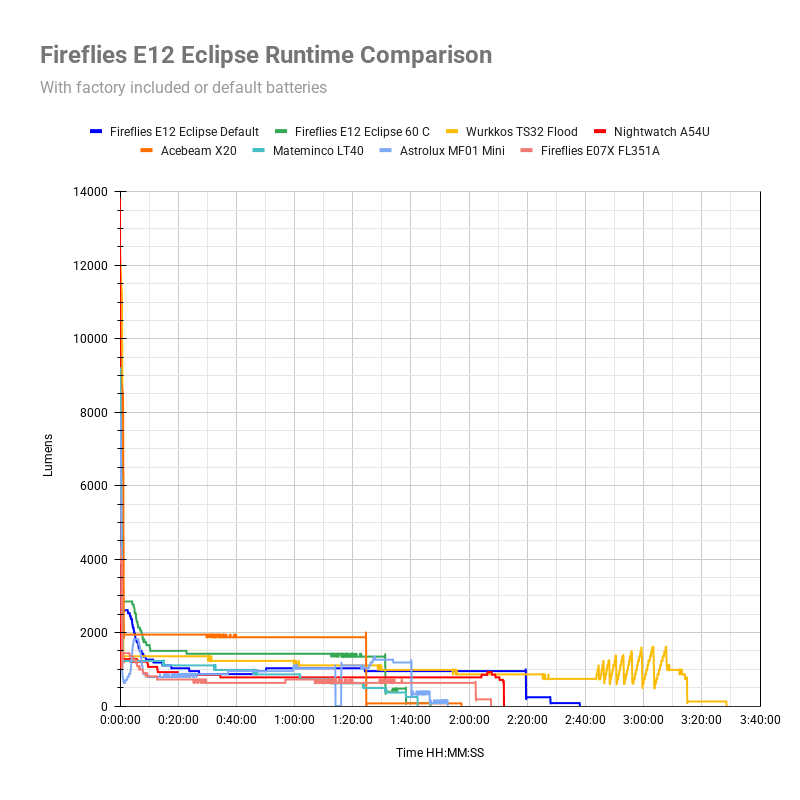
Fireflies, like Hank and Simon (Convoy) don't bother buyers with runtime data like the big brands do, so dust off your imagination and use it for those. The E12 put on quite a show with the output performance and runtimes. How a light this small runs this good is beyond me because it's put up some of the best output I've ever seen in a single cell flashlight. Period.
I ran Turbo twice, once at the default thermal ceiling (50 C) and bumped to 60 C to see how it would affect the output. In short, it did, and in a meaningful way (surprisingly). Turbo (default) starts under spec, and bumping it to 60 C doesn't get much more (395 Lumens).
Both Turbo runs exhibited the same step down behavior: A very steep drop from 9000+ Lumens down to about 2200 Lumens around the 20 second mark for the default setting and another 10 seconds for 60 C, so upping the limit does give you a bit more max output, even though the indicated (per my instruments) head temperature only read about 48 to 50 C. My guess is the step down is measured at the driver, which gets hot much faster than the head.
After stepping down, the output carries on around 2600 and 2800 Lumens, with drops along the way, gradually flattening out into constant, regulated output. By 30 minutes, the 60 C ceiling is carrying about 500 Lumens over the default, narrowing up a bit by 60 minutes (1027 versus 1422).
The 60 C ceiling hits LVP by 98 minutes in when default is still chooching along at almost 950 Lumens. I ended the 60 C test at 1 hr 46 minutes, and default ran for almost another 60 minutes before I ended that run.
Should you bump the thermal ceiling? I think so, but the penalties are shorter runtimes and a hotter host: The 60 C run made the E12 untenable for bare hands by about 6 minutes in, but cooled enough by 15 minutes for bare hand use whereas the default run was hand-friendly the entire runtime.
For the rest of the tested brightness levels, L6, and L5 are much more useful than Turbo, with each holding their respective high outputs for much longer after the step down, with L6 and L5 both more or less coalescing their outputs by about 20 minutes in at 1100 Lumens and 1000 Lumens by 60 minutes.
L4 will give the most stable, regulated brightness, with no interruptions,starting at, and maintaining about 700 Lumens for nearly four hours. Pretty snappy! LVP is typical Anduril behavior, with a drop to 200+ Lumens, then another drop to a lower output, then dropping to a barely-there output where it stays forever. You could reactivate the light after the LVP drop, and you get roughly up to L4 brightness for short periods. The battery was discharged consistently to 2.9 to 2.8 volts.


Fireflies Flashlight Runtime Comparison
We get an idea of just how special the E12 is in the comparison tests: No other factory multi LED single 21700 light out there can beat it for output. The closest competitor is the Mateminco LT40, and the others are muti-cell lights like the Acebeam and Wurkkos. Overall, the E12 is a very impressive flashlight!

Peak beam intensity and beam distance measurements
About Peak beam intensity: Understanding ANSI FL1 Standard
About peak beam intensity: The calculated value of distance in meters at which the flashlight produces a light intensity of 0.25 lux. (0.25 lux is about the brightness of a full moon shining on an object). This means that the intensity has decreased so much, it becomes difficult to see darker objects, or objects that don't reflect light. The columns ‘Meters’ and ‘Yards’ use rounded numbers.
Beam distances are measured using a Testo 545 luxmeter measured indoors at 5 meters using a fully charged included TenPower 50XG battery. Measurements taken at 30 seconds. The light was allowed to cool and recharge between the L6 and Turbo measurements.
| Mode | Specified intensity | Specified beam distance | Candela measured | Meters | Yards |
|---|---|---|---|---|---|
| L1 | ? | ? | N/A | N/A | N/A |
| L2 | ? | ? | 115 cd | 21 m | 23 yd |
| L3 | ? | ? | 1960 cd | 88 m | 97 yd |
| L4 | ? | ? | 7550 cd | 174 m | 190 yd |
| L5 | ? | ? | 20,921 cd | 289 m | 316 yd |
| L6 | ? | ? | 35,226 cd | 375 m | 411 yd |
| Turbo throw | ? cd | 700 m | 26,617 cd | 326 m | 357 yd |
Ambient temperature during testing:
- 20 °C
No beam distance measurements for the E12 were specified by Fireflies, save for a single 700 meter figure for Turbo. By ANSI, the output has already stepped down, so the throw isn't too impressive. Bumping the thermal ceiling extends the reading to just ANSI, so it's higher. At turn-on, I got 117,143 cd for 648 meters, which from a 49 mm head, with TIRs, is pretty fantastic.

Beamshots
Camera settings and distance: Photos taken with a Canon EOS R100 with Canon RF-S 18-45 mm STM lens. The camera is set to 0.3s, F5 ISO1600 and 5000K WB. The fence is 95 meters distant.
Beamshots of the following flashlights compared:
- Fireflies E12 Eclipse
- Fireflies E07X Canon
- Fireflies X4 Stellar SFT-25R
- Fireflies E04 (with FFL505UT emitters)
- Nightwatch A54U
- Astrolux MF01 Mini
Please note that the following beamshots are mainly intended to showcase the beam pattern and beam quality, rather than overall performance. These images are typically taken directly after activation, and in different seasons or weather conditions, and therefore do not fully represent its overall performance. In few cases the camera settings are even different and therefore not meant for performance comparisons. For accurate performance metrics, such as output, beam distance, and runtimes, you need to look at the performance section of this review.


Disclaimer: This flashlight was sent to us for review at no cost by Fireflies. We have not been paid to review, nor have we been holding back on problems or defects.

Final Verdict
 Pros
+Great build quality
+Excellent beam
+Fully regulated output
+Fantastic performance
+Compact size
+Lots of LED choices
+Onboard charging with power bank
 Cons
-Turbo step down is fast
-Expensive
-Power bank requires switching to momentary mode
Explanation on star ratings:
1: Avoid: my phone flashlight would be a better choice - 2: Poor: significant defect or issues; almost unusable - 3: Average: some defects or issues; but still usable 4: Good: recommended (minor issues) - 5: Great: highly recommended

5 stars: ★★★★★
Note: Our star ratings serve as a general guide, but we advise against placing too much emphasis on individual scores. Each reviewer brings their own perspective, and there is no standardized scoring system to reflect the intricate preferences of all flashlight users. Read the full review to help you make your decision, focusing on the overall performance and the features that matter most to you.
Wrapping up this review, I can honestly say one phrase stands out more than any other…Worth the wait. The original E12R disappeared way too soon, replaced by the E12C which was okay, but more of a placeholder. When that one went the way of the dodo, we were left with sad hearts and nothing to spend our allowances on, until now. I didn't get an original, and I pined over one for a bit, but this new E12 is the best one yet and has made me forget about the original. I think our readers will agree.
First off, the host. It's well-made and compact, but elegantly simple like the other E-series lights, sort of a Goldilocks form factor; easy to handle, balanced, pocketable (somewhat). The fact you can swap the magnet out is also nice, and I always appreciate Fireflie's phobia of the word starting with g and ending with lue, which leaves room for tweaking and refining with other LEDs. The optic is pretty much perfectly matched to the SFT-25R in my tester with lots of beam distance and great coverage. Honestly, for 6500K LEDs, the tint is totally fine and makes me forget about R9050 LEDs.
The Eclipse also surprised me in other areas: All the things I like about the E07X, E04, E90, and even the X4 Stellar, have been homogenized into the E12 Eclipse. On top of that, the new Lume10 driver just works awesome. Combined with the 50XG battery and a conservative thermal ceiling, the E12 put up some of the best performance I've seen from a single cell multi-LED light…ever. Seriously, nothing comes close in this class and size, and it's perfectly regulated as well. Even at 50 C, it's awesome. Anduril 2 is present, and love it or leave it, it is the exemplary enthusiast flashlight UI, and the Advanced Aux tweaks, while still in their infancy, is a nice launchpad for creativity and customization for those with the know-how.
There's not much I'd change here, and none of these would stop me from buying one. It is a bit pricey for sure. The step down for Turbo is fast, and upping the thermal ceiling didn't affect it too much, but that's to be expected on a hot rod light. The power bank, while nice to have, isn't plug n play and requires switching to momentary mode.
If you weren't able to get the first E12R, and passed on the E12C, then clean under your couch cushions, car seats, junk drawers for change, sell your Hank lights, hawk that Ken Griffey Jr rookie card, sell your grandma's vintage cameo (wait, don't do that), and pick up an Eclipse. Seriously, it's that good and I think it is one of the best all-around compact enthusiast lights on the market at the time of this review, and gets my highest recommendation.
Use code: 1lumen & Get 10% off anything at Fireflies Outdoor store
1lumen selects and reviews products personally. We may earn affiliate commissions through our links, which help support our testing.